 IT Consulting
 Cloud Migration Services
 IT Infrastructure Projects
 Business Continuity Planning
 IT Procurement
 Managed IT Services
 IT Support Services
 Managed Cloud Services
 Managed SharePoint Services
 End User Computing
 Unified Communications
 Connectivity
 Virtual CIO
 Managed Security Services
 ACSC Essential 8
 Cybersecurity Risk Assessment
 Cloud Backup and Disaster Recovery
 Cyber Security Connect and Protect Program
 IT Strategy
 Microsoft 365 Consulting Services
 Power BI
 Awards and Certifications
 Management Team
 Our Commitment to the Environment
 CSAT Charity Donations
 Media Kit
 Sydney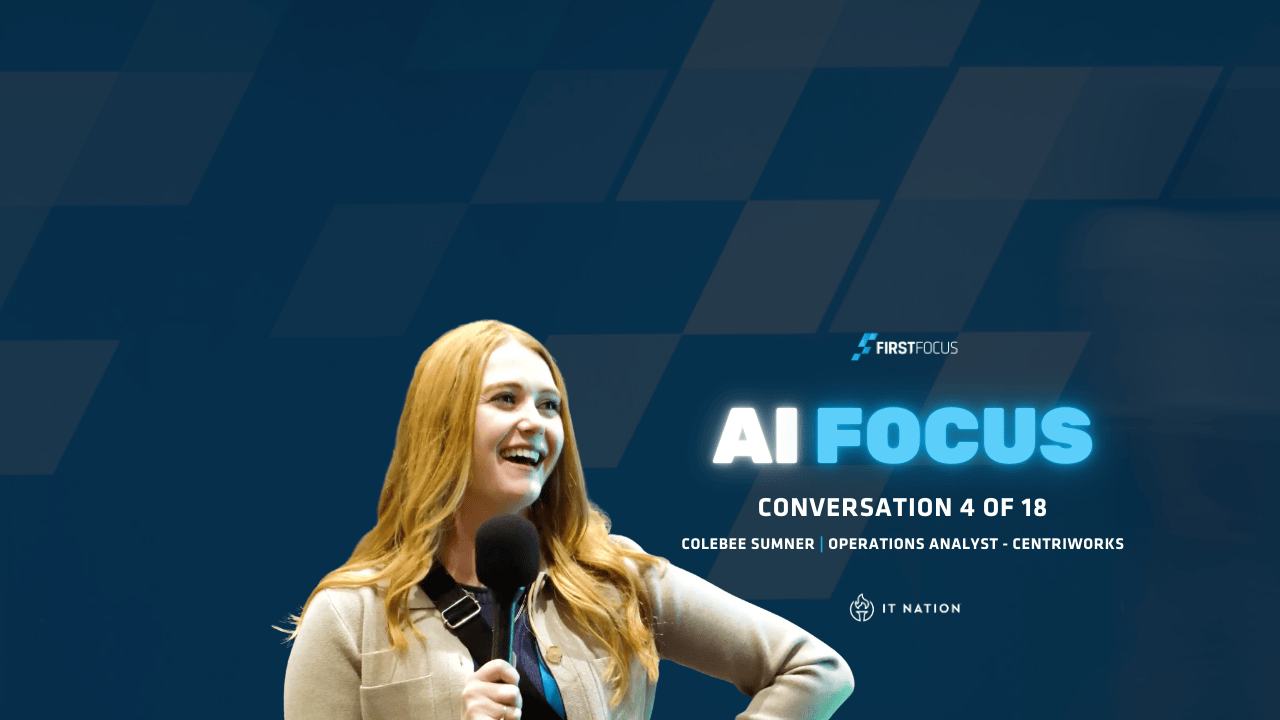
How MSPs Are Harnessing AI Agents, Copilot and Internal Automation to Transform Their Operations
This episode of AI Focus, recorded at IT Nation Connect in Orlando, uncovers how a Tennessee-based MSP owner is building practical AI capability inside their business. The conversation highlights the tools they rely on, the agent-style automations they’re deploying, and the lessons every Australian MSP and mid-sized business can draw from the current wave of AI adoption. It’s a grounded look at what real operators are doing, why it matters, and how AI is reshaping day-to-day work.
Key takeaways
- AI agents built in Microsoft Copilot Studio are helping MSPs reduce repetitive work.
- Process-building agents create strong first drafts that teams can refine quickly.
- Internal AI systems are emerging as a way to support staff and reduce email back-and-forth.
- AI vocabulary is becoming messy, with automation often mislabelled as “AI”.
- Many organisations still feel uncertain or anxious about AI adoption.
- Using AI well is becoming a competitive advantage for individual staff, not just businesses.
- MSP leaders expect their people to upskill and adopt tools like Copilot as part of everyday work.
- The AI landscape still feels like the “wild west”, but maturity and clearer rules are coming.
- Early adopters use their own AI journey as credibility when speaking with clients.
- The best value of AI comes from linking tools to real business outcomes and workflow gains.
Watch the episode
Why AI is Becoming Essential Inside MSPs
Australian organisations are moving quickly to understand how AI fits into their operations. MSPs in particular are under pressure to adopt these tools early, both to improve internal efficiency and to guide clients on the same journey. In this episode, Brendan Richie speaks with an MSP owner from Knoxville who shares exactly how they’ve started adopting AI in a practical, hands-on way. The discussion reflects challenges that many Australian businesses face, especially those building automation capability without dedicated data or AI teams.
The guest explains that their business transitioned from a traditional technology services provider into a managed service provider back in 2017. Since then, efficiency and process optimisation have become central to their operating model. AI is now the next logical step, tying into workflow improvements, client service consistency and staff productivity. Their experiences mirror what many Australian MSPs are seeing, with AI already shifting expectations around delivery, cost control and service scalability.
Building AI Agents with Microsoft Copilot Studio
One of the strongest themes in the conversation is the practical use of Microsoft Copilot Studio. Rather than chasing hype or experimental models, the MSP owner is focused on building AI agents that remove repetitive work. This aligns closely with what we see across the Australian market: businesses are looking for immediate wins rather than theoretical future benefits.
The guest describes themselves as “basic” in terms of AI use, yet their projects are anything but. They’ve begun designing agent workflows that take routine tasks off their team’s plate. Their simple philosophy is clear: if a task is repetitive and consumes time, automate it with an agent. In many cases the work is structured enough that a Copilot-powered agent can complete most of it, leaving staff to manage exceptions or refine outputs.
For MSPs and mid-sized businesses in Australia, this mindset is becoming standard. The goal is not to replace roles but to shift repetitive work away from people so they can focus on value-adding tasks. Organisations with distributed teams or heavy process requirements benefit most, and Copilot Studio provides a controlled way to experiment with automation without needing specialised coding skills.
A Process-Building Agent That Took Weeks of Work Down to Minutes
One example shared in the episode is a process-building agent. Instead of drafting multi-step workflows manually, the MSP’s team inputs high-level requirements and lets the agent generate a full structured process. They then review, adjust and refine it. Tasks that once took days or even weeks now begin with a high-quality first draft in minutes.
This shift in speed is one of the clearest demonstrations of AI value. In many Australian organisations, documentation is often deprioritised or rushed because of time pressure. Using AI to produce a structured starting point reduces this friction dramatically. It also raises quality by ensuring that the initial draft is complete, consistent and aligned with the organisation’s existing language and standards.
For MSPs, having stronger internal documentation improves onboarding, reduces errors, and supports scalable operations. When tied to governance and service delivery, it helps maintain consistent standards even as teams grow or shift responsibilities.
From Experiments to Measurable Impact
Although the guest hasn’t yet tied these AI initiatives directly to measurable P&L outcomes, they expect to see this in the coming year. This reflects the reality for many Australian MSPs: AI adoption is still early, and its financial impact is often indirect. Productivity, lower operational costs, better forecasting and improved customer experience all contribute, but the return is gradual and builds over time.
The MSP owner shares that their organisation is working on several major internal projects. Their most ambitious goal is to build an internal AI system designed specifically to support their staff. Rather than relying solely on vendor-provided tools, they are designing an in-house model that acts as a knowledge and process assistant. Staff will be able to query it, ask for help, and receive immediate answers without excessive back-and-forth.
This is becoming a global trend. Many Australian organisations, especially MSPs and professional services firms, are exploring internal AI models trained on their own procedures, past tickets, documentation, project notes and governance structures. The aim is workplace optimisation. If a team member can ask the AI instead of chasing multiple colleagues, both productivity and response times increase.
Using Your Own AI Journey to Build Client Trust
Another strong insight from the episode is the strategic advantage of using AI within your own business before advising clients on AI adoption. The MSP owner wants to build credibility by demonstrating the tools and processes they’ve implemented themselves. This is increasingly important in Australia, where organisations expect service providers to lead by example.
The ability to say “we use this internally, and here’s the improvement we’ve seen” is far more persuasive than proposing solutions from the outside. It also ensures the MSP can speak with confidence about implementation requirements, staff readiness, governance concerns and operational impacts.
For Australian businesses, showing lived experience with AI is becoming part of the trust equation. Whether it’s automation, co-pilots, agent systems or internal models, demonstrating internal usage builds stronger relationships with clients who may still feel hesitant or overwhelmed by the pace of change.
The Frustration: Too Much Is Being Called “AI”
The guest highlights a frustration shared across the industry: the term “AI” is being used too loosely. Many tools labelled as AI are simply workflow automation, RPA or simple rule-based tasks. Overuse of the word makes it harder for clients to understand what’s real, what’s helpful and what’s genuinely new.
Australian executives are experiencing the same challenge. Vendors are often marketing features as agentic AI, intelligent automation or next-generation learning models when the underlying functionality is relatively basic. This creates confusion and raises expectations unrealistically.
The MSP owner stresses the need for more precise vocabulary as the market matures. As regulations evolve and tools become more standardised, the language around AI will stabilise. This mirrors the early days of cloud services, where everything from hosting to storage to virtualisation was rebranded as “cloud”. Over time, language settled and clarity returned.
The “Wild West” Feeling of the AI Revolution
Three years into widespread AI adoption, the guest describes the period as the “wild west”, lots of energy, rapid evolution and few rules. This analogy reflects what many Australian businesses feel today. The speed of change, the volume of new tools and the lack of consistent standards all contribute to a sense of experimentation.
The guest compares the current moment to the industrial revolution, where technology arrived before rules caught up. They expect the next phase to involve consolidation, clearer frameworks and more predictable performance across AI systems.
During this early period, organisations that test, learn and experiment will be better positioned when standards settle. MSPs that build internal expertise now will become go-to advisors for their clients over the next few years.
Jobs, Anxiety and Why AI Adoption Still Matters
The conversation also touches on concerns from clients around job security and disruption. Staff worry about job losses, additional training demands and the speed at which new tools arrive. This sentiment is common across Australian workplaces.
The MSP owner takes an optimistic stance: AI will not take jobs, but people who use AI well will outperform those who don’t. Productivity, accuracy and speed all improve when AI is used effectively. This reinforces the idea that capability uplift is becoming a non-negotiable element of modern work.
The guest makes this clear to their own team. They encourage staff to explore tools like Copilot, share effective prompts and contribute learnings whenever they uncover a better way to work. This culture of experimentation ensures the benefits of AI scale beyond leadership into day-to-day operations.
The Importance of Internal Skills and Shared Learning
One of the strengths of the MSP’s approach is their focus on upskilling their team. Whenever they find a prompt or workflow that works well, they share it across the business. This creates a repeatable cycle where wins aren’t isolated to one department.
Australian organisations that succeed with AI are the ones that formalise this sharing process. They build internal prompt libraries, run short lunchtime training sessions, integrate Copilot into onboarding and encourage staff experimentation with guardrails. This promotes confidence and improves the consistency of AI-generated outputs.
Small, repeatable wins compound into significant operational improvements over time. When paired with automation through Microsoft 365, SharePoint, Power Automate or Copilot Studio, the gains can be substantial.
Community, Conferences and Connection
The episode finishes on a lighter note, touching on the energy of IT Nation Connect and the value of spending time with peers. For many MSPs, events like this create space to share practical learnings and build community. They also provide insight into where global vendors are heading with their AI roadmaps, which helps local businesses plan their own strategies.
These conversations mirror what we see in Australia: MSP leaders value chances to compare notes, learn from others and build networks that support them through rapid change. AI is evolving fast, and the more connected the community is, the easier it becomes to navigate new developments with confidence.
Where AI for MSPs Goes Next
This episode underscores a clear message: AI adoption inside MSPs is no longer theoretical. Tools like Copilot, agents, workflow automation and internal knowledge models are becoming the backbone of modern operations. Australian MSPs and mid-sized organisations can draw heavily from these lessons.
The organisations that experiment now, build internal capability and refine their workflows early will be better prepared as the AI landscape matures. Whether the goal is efficiency, client experience, governance or cost reduction, AI is reshaping how teams work, and the opportunity is only growing.