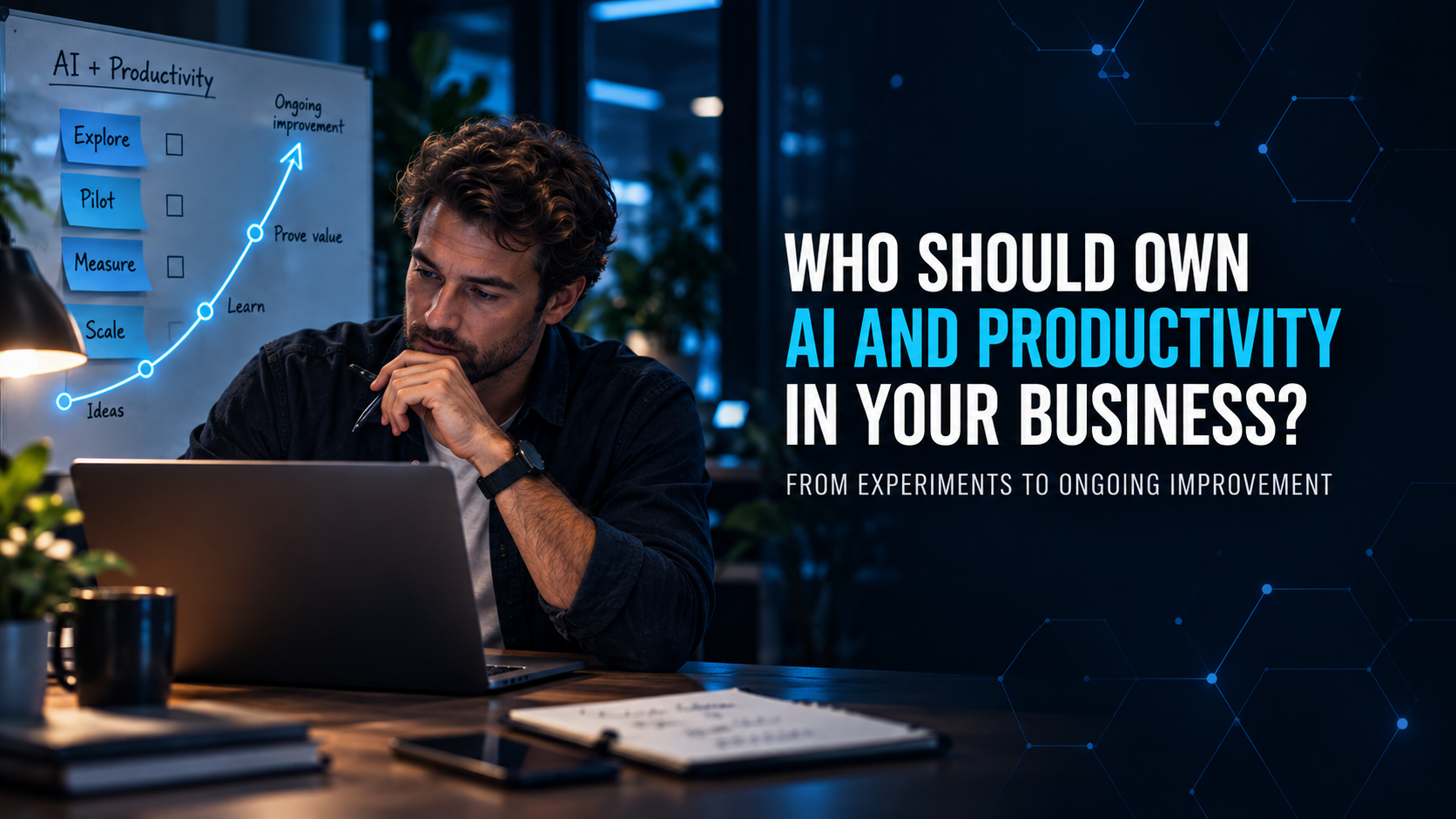
Who Should Own AI and Productivity in Your Business?
Getting real value from AI and automation is a habit, not a one-off rollout. The businesses making steady progress keep looking for ways technology can help people work better, and that needs clear ownership. Someone has to keep asking what should improve next, decide what is worth pursuing and make sure useful changes do not fade after the initial excitement. With that responsibility in place, productivity becomes something the business can improve month by month.
The Short Version
01
Most businesses have people experimenting with AI and automation, but no one accountable for turning that activity into ongoing improvement.
02
Productivity works better as a monthly operating habit than a once-a-year strategy exercise.
03
The business should keep ownership of its priorities. A named technology owner can help identify, prioritise and carry the right improvements through.
Who Owns Productivity?
Everyone’s Job, So Nobody’s
Ask who owns productivity and you often get a pause. Operations, finance and leadership all care about it. IT, data and AI all influence it.
But when responsibility is spread across several people, there is rarely one person keeping the work moving. Experiments stay in pockets, useful ideas compete for attention and early momentum quietly fades.
The question is not whether people are trying new tools. It is whether someone is responsible for deciding what is worth pursuing, removing the blockers and making sure useful changes become part of how the business works.
What Changes
What Changes When Someone Owns It?
| Without an owner |
With an owner |
| AI and automation are tried in pockets |
Opportunities are reviewed across the business |
| Effort fades after the early excitement |
Improvement becomes a regular monthly habit |
| No one knows which changes are helping |
What works is reviewed and built on |
| Poor data quietly limits results |
Data gaps are identified before they block progress |
| Wins are one-offs |
Useful changes are repeated and extended |
A Simple Operating Habit
The Monthly Productivity Review
This is the heart of it. Rather than waiting for an annual strategy session, the owner runs a short review every month and comes back to one question:
What can we change this month to help the business work better?
The conversation should stay practical and work through the same prompts:
- Where are people wasting time, and what would fix it?
- Which team is ready to use more AI or automation, and which needs more training?
- Which workflow should we improve next?
- Where have AI or automation efforts stalled, and what is getting in the way?
- Where is poor data holding back better outcomes?
- What did last month’s changes improve, and what should we build on next?
AI isn’t something you implement. It’s something you continuously improve.
Knowing What to Prioritise
None of this is about buying more AI. Most businesses already have people experimenting and plenty of technology within reach.
The harder part is deciding which opportunities are worth pursuing, what needs to happen first and which ideas should be left alone. That judgement is what an owner brings. It turns scattered experimentation into a repeatable way of improving how the business works.
Technology doesn’t create competitive advantage. Knowing what to prioritise does.
So Who Should Own It?
The business should still own its priorities. The question is who owns the technology process that turns those priorities into action.
For many businesses with 20 to 200 people and no internal IT team, that responsibility ends up spread across the CEO, operations, finance and whoever knows the systems best. Each person has a stake in the outcome, but no one has the time or mandate to keep reviewing what should improve next.
That is one of the gaps CORE is designed to fill. CORE is First Focus’s Managed AI & IT Services offering for businesses without internal IT. It brings day-to-day IT support, cybersecurity, data and SharePoint governance, AI adoption, automation and ongoing technology guidance under one accountable team.
The role is not to introduce more technology for the sake of it. It is to keep the environment supported and secure while helping the business identify practical opportunities, prioritise what matters and keep useful improvements moving.
The business decides what matters. CORE helps turn those priorities into an ongoing technology plan.
Where CORE Fits
Give the Improvement Process a Clear Owner
If your business does not have someone owning this process today, see how CORE brings IT, security, data, AI and ongoing improvement together under one accountable team.
Explore CORE, First Focus’ Managed AI & IT Services
Common Questions
Frequently Asked Questions
Who should own AI and productivity in a business?
▾
The business should own its priorities, but one person or team should own the process of finding, prioritising and carrying technology improvements through. Without clear ownership, AI and automation efforts tend to stay scattered across teams.
What should a monthly productivity review include?
▾
A monthly review should look at where people are losing time, which workflows should improve next, whether teams need more AI support or training, where data is getting in the way and what last month’s changes actually improved.
Does the productivity owner need to be an AI expert?
▾
Not necessarily. The role is less about knowing every AI tool and more about understanding business priorities, spotting useful opportunities, bringing in the right technical knowledge and making sure improvements are carried through.
Can an external IT provider own the technology improvement process?
▾
Yes, if the provider is set up to do more than day-to-day support. The business should still decide its priorities. A broader managed service can help review opportunities, provide technical guidance, support AI adoption and keep agreed improvements moving.
Video Transcripts
Read the Full Video Transcripts
Video: Who Owns Productivity in Your Business?
▾
Who owns productivity in your business?
Imagine if every month someone sat down with you and asked: where are your people wasting time? What process frustrated your team this month? What are we automating next month? Which departments are adopting AI well, and which departments need more training? Where is poor data stopping us getting value from AI? Which automation is no longer delivering value?
All of those questions, they’re not part of an annual strategy session. That’s how the highest-performing businesses will operate, because AI isn’t something you implement, it’s something you can continuously improve.
So I’ll ask again, who owns productivity in your business?
Video: Imagine If Productivity Had an Owner
▾
Your problem isn’t access to technology. Your business, I’m sure, already has the tools. You’ve got Microsoft 365, maybe automation platforms, you’ve probably bought some AI licences. But what you may not have is ownership over the return those platforms generate.
So who is actually responsible in your business for finding where people are wasting time? For asking which teams are ready for more AI? Which workflow should be automated next? Which tools are not being adopted, or where poor data is slowing the business down? Which projects should stop because the return isn’t there?
That is the gap we see. Without continuously posing those questions, AI becomes another experiment, automation becomes another idea, and productivity becomes something everyone talks about but no one actually owns.
Because technology does not create competitive advantage on its own. Knowing what to prioritise, that does.
So the real question: who owns the return from technology in your business?

 IT Strategy
 IT Consulting
 Data Services
 IT Infrastructure Projects
 IT Procurement
 Business Continuity Planning
 Virtual CIO
 Cloud Migration Services
 Managed IT Services
 IT Support Services
 Managed Cloud Services
 Managed SharePoint Services
 Unified Communications
 Connectivity
 Offshore Staff Outsourcing (BPO)
 Managed Security Services
 ACSC Essential 8
 Cybersecurity Risk Assessment
 Cloud Backup and Disaster Recovery
 Cyber Security Connect and Protect Program
 Automation
 Power BI
 Careers
 Awards and Certifications
 Management Team
 Case Studies
 Sell Your IT Business
 Our Commitment to the Environment
 CSAT Charity Donations
 Media Kit
 Sydney