
Infrastructure-as-a-Service (IaaS) is integral to modern IT environments, forming the basis of many cloud computing solutions.
Its flexibility provides a degree of control over IT resources that organisations need to enable scalability by switching resources on and off as needed.
IaaS is a cloud computing solution that virtualises IT infrastructure – servers, storage, and networking solutions – and makes them available on demand over the internet, usually with a pay-as-you-go arrangement.
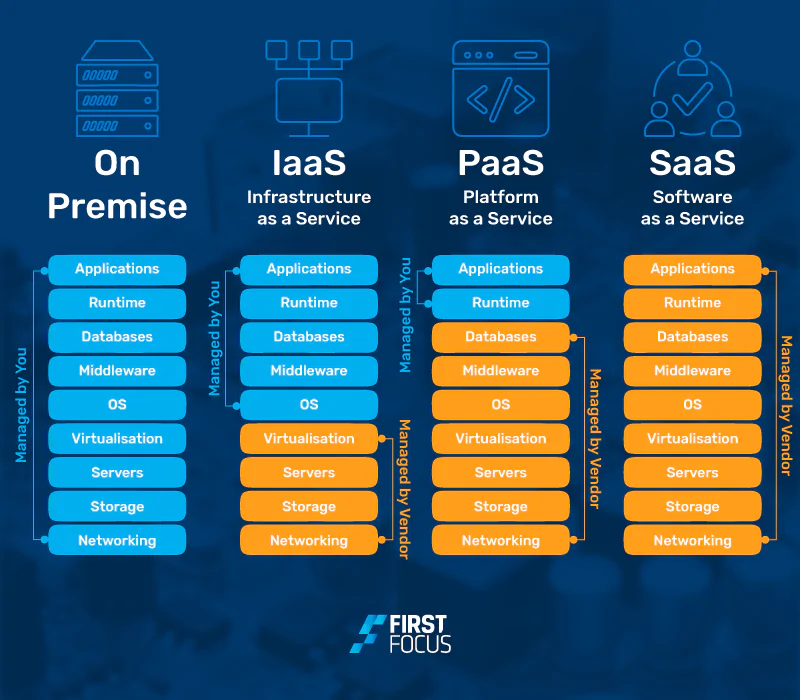
While cloud computing includes a wide range of solutions, IaaS differs in that it only delivers access to infrastructure-based resources. The user gets access to barebones computing resources and can choose what they want to do with them – it does not involve supplying operating systems, dev tools, or applications.
This focus means that IaaS doesn’t always fit the needs of every organisation. Being free to configure on-demand computing resources can be a blessing in some cases and a burden in others.
There are three different types of IaaS: public, private and hybrid.
Public IaaS – this solution is usually offered by a cloud provider as their cheapest option. Public IaaS hosts IT infrastructure resources for a range of clients, enabling access to dev and test environments and hosting for customer-facing websites and applications. The infrastructure is virtualised and shared between clients.
Private IaaS – this option offers infrastructure dedicated entirely to your organisation. The resources are provisioned and reserved for you and can be customised to suit your needs on demand. These features mean you have guaranteed access to the resources you need, as and when you need them – but at a higher cost than the public option.
Hybrid IaaS – combining elements of both public and private options, hybrid IaaS can be helpful when your organisation needs the scalability of public IaaS with the reliability benefits available in a private solution. These environments often require careful management to get the best use out of each infrastructure platform.
So, what do IT managers want from these abstracted infrastructure solutions?
IaaS offers IT Managers several advantages over in-house IT infrastructure solutions. These advantages include increased agility, flexibility, and scalability. The advantages that concern IT managers usually revolve around speed – being able to quickly deploy computing resources such as storage, computing power, or networking without needing additional hardware is a big benefit over static infrastructure.
In general, these features are used to improve organisational efficiency and agility – including self-service provisioning and pay-as-you-go pricing. By taking advantage of these features, IT managers can deliver an IT environment that grows and shrinks to meet their needs – and budget – at specific points in time.
While scalability is often noted as the main benefit of cloud solutions, IaaS focuses on what these fast responses mean on an infrastructural level.
 Incremental costs – until you can buy half a server, IaaS offers the most flexible way to quickly access the resources you need. Solutions that charge based on time and that don’t demand lock-in contracts provide a scalable way to control these costs. In cases where incremental use of computing resources is likely, it makes sense to only pay for the infrastructure you need. This option eliminates the capital expense of deploying in-house hardware and software, passes the operational maintenance costs on to the provider, and can be more affordable than other options like virtual private servers.
Low management – the hardware that delivers your IaaS solution is managed by a third party rather than an in-house team. This third party is responsible for uptime, responsiveness, and physical security – meaning your organisation does not have manage ongoing hardware maintenance.
Responsive – IaaS can give your business more flexible control over its IT systems, provisioning for workloads as and when required. This elasticity allows for fast responses to changing circumstances. And given the issues of supply chain disruption, fluctuation of chip prices, and the cost of premises needed to house hardware, these options are even more valuable.
Although IaaS has many benefits, it has some flaws that should be addressed when considering its use.
 No physical access – with IaaS, you do not directly control your infrastructure, as you don’t have access to any physical hardware. Instead, you manage abstracted compute, storage, and networking resources based on the permissions set by the provider. Moreover, most public IaaS solutions are multi-purpose solutions aimed at the broadest possible markets. These solutions generally don’t allow for the inclusion of specialist hardware that may be required in specific industries.
Increased maintenance – while IaaS moves the burden of hardware management to a cloud provider, it does not offload the same environment configuration work or other day-to-day maintenance operations as other cloud computing models. You are still responsible for the upkeep of your operating systems, databases, and user applications. This requirement means that IaaS clients need to be more involved in managing their IT environment, which can put it at a disadvantage when compared to PaaS and SaaS solutions.
Bills and accounting – while IaaS can be more cost-efficient than on-prem solutions, the granular nature of IaaS billing can complicate budget forecasting and other accounting activities. IT managers will need to continually monitor their IaaS environment to better understand which workloads require which resources and plan projects carefully to make sure they include changes in computing resource usage.
The business case for IaaS solutions boils down to a few key elements.
Stability – the scalability enabled by IaaS offers value through flexibility. If your IT needs are in flux, IaaS can make sense. However, if your needs are stable – and will be for some time – other solutions may be more financially viable.
Control – with IaaS, you manage the entire software and OS stack while your cloud provider manages the hardware. If your organisation needs control over these assets, but is not suited to manage the infrastructure, then IaaS makes sense. Purchasing solutions from a licensed IaaS provider is also a quick and easy way to ensure that your compute resources meet specific compliance requirements.
Efficiency – as with most business decisions, the return on investment must be considered as part of the purchasing process. Migrating from on-prem solutions to cloud infrastructure is a decision that cannot be undone quickly. So, it pays to ensure that your efficiency returns outweigh both the transformational and the ongoing costs.
When evaluating IaaS, be sure to ask your provider about the services they offer and what they can do for you.
List your requirements and see if they can work with you to meet your needs. And don’t be afraid to ask for references or speak with other customers of the provider to get an idea of what their experience has been like.
This way, you’re more likely to find an IaaS provider that delivers peace of mind, not just cloud infrastructure.

 IT Strategy
 IT Consulting
 Data Services
 IT Infrastructure Projects
 IT Procurement
 Business Continuity Planning
 Virtual CIO
 Cloud Migration Services
 Managed IT Services
 IT Support Services
 Managed Cloud Services
 Managed SharePoint Services
 Unified Communications
 Connectivity
 Offshore Staff Outsourcing (BPO)
 Managed Security Services
 ACSC Essential 8
 Cybersecurity Risk Assessment
 Cloud Backup and Disaster Recovery
 Cyber Security Connect and Protect Program
 Automation
 Power BI
 Careers
 Awards and Certifications
 Management Team
 Case Studies
 Sell Your IT Business
 Our Commitment to the Environment
 CSAT Charity Donations
 Media Kit
 Sydney