 IT Consulting
 Data Services
 IT Infrastructure Projects
 IT Procurement
 Business Continuity Planning
 Cloud Migration Services
 Managed IT Services
 IT Support Services
 Managed Cloud Services
 Managed SharePoint Services
 End User Computing
 Unified Communications
 Connectivity
 Virtual CIO
 Offshore Staff Outsourcing (BPO)
 Managed Security Services
 ACSC Essential 8
 Cybersecurity Risk Assessment
 Cloud Backup and Disaster Recovery
 Cyber Security Connect and Protect Program
 Automation
 IT Strategy
 Microsoft 365 Consulting
 Power BI
 Careers
 Awards and Certifications
 Management Team
 Case Studies
 Sell Your IT Business
 Our Commitment to the Environment
 CSAT Charity Donations
 Media Kit
 Sydney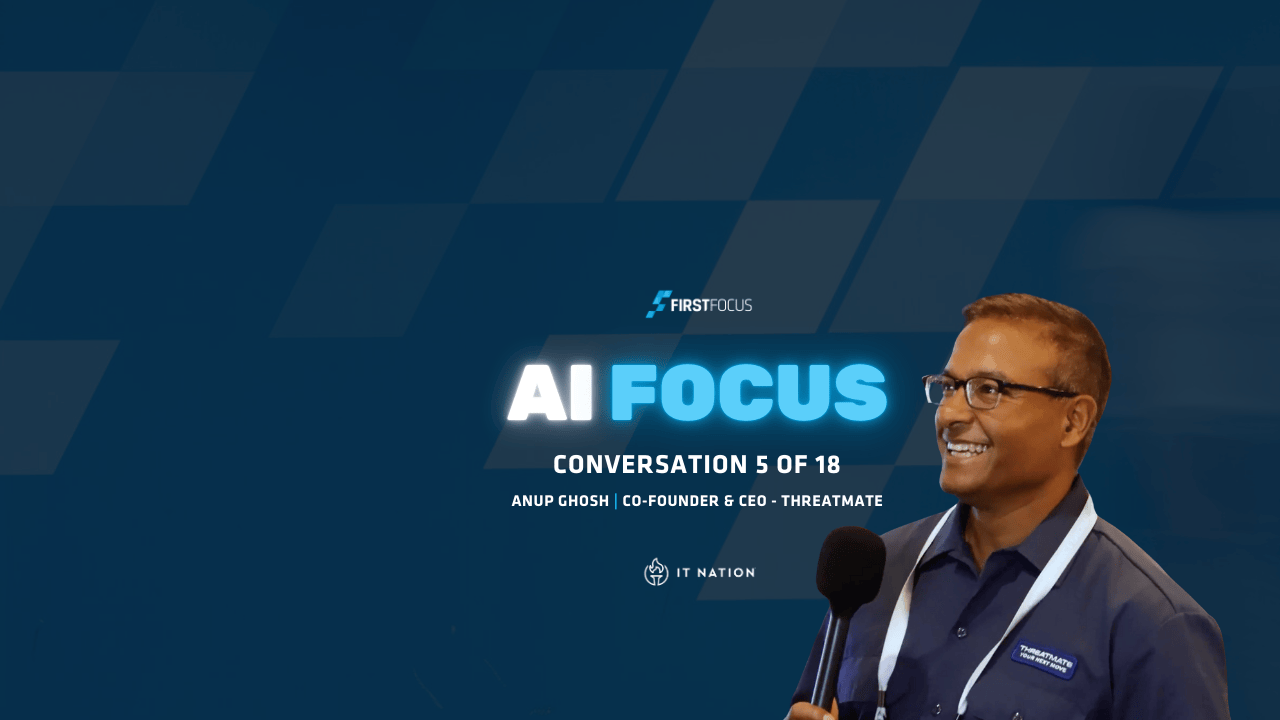
How AI Is Advancing Pentesting, Productivity and Skills Development for MSPs
Recorded live at IT Nation Connect Global in Orlando, this AI Focus episode features Brendan Ritchie in conversation with Anup Ghosh, Co-Founder and CEO of ThreatMate. The discussion explores how AI is accelerating automated pentesting, what value MSPs can unlock right now, and how AI is reshaping junior technical roles. For Australian MSPs and businesses looking to balance innovation with measurable ROI, this episode provides practical clarity on where AI is delivering real operational impact today.
Key takeaways
- AI is now embedded directly into modern pentesting tools, improving how attack vectors are selected and executed.
- ThreatMate is pushing beyond automated pentesting into full AI-driven offensive security.
- Notebook LM is emerging as a powerful content tool that can even produce podcast-style dialogues.
- The AI hype cycle is fading and giving way to value-focused adoption.
- For MSPs, the biggest AI dividend is time saved through automation.
- AI adoption should be grounded in ROI rather than novelty.
- AI-assisted coding can cover junior-level programming tasks and improve engineering efficiency.
- AI replaces junior tasks, not junior roles, and oversight still matters.
- AI-driven upskilling requires strong review processes to ensure quality.
- Vibe coding by leadership can be innovative, but needs structure and governance.
Watch the episode
AI-powered pentesting and attack surface management
ThreatMate launched in 2023 with a clear mission to automate offensive security in a way that is intelligent, adaptive and scalable for MSPs. As Anup Go explains, the platform uses AI to analyse attack surfaces and select the most relevant attack vectors to run against each environment. This is a significant step beyond vulnerability scanning, giving MSPs deeper visibility and stronger security outcomes with less manual engineering.
For MSPs supporting Australian businesses, this level of automation is increasingly necessary. The threat landscape is expanding, the skills market is tight and clients expect rapid, always-on protection. AI-enabled pentesting shortens testing cycles, improves prioritisation and supports better remediation outcomes.
Beyond the hype cycle and into real value
A key theme in the discussion is the industry shift away from hype-driven excitement and toward value-driven adoption. Anup notes that every major technology goes through a hype cycle, but AI is now entering its maturity stage. Leaders are starting to ask a simple question. What value does this tool actually deliver
For MSPs, that value is time. AI can automate manual workflows, streamline engineering tasks and reduce administrative overhead. In the Australian market where labour costs are high, time savings translate directly into stronger margins and more predictable operations.
Notebook LM and the future of MSP content creation
An unexpected highlight in the conversation is Anup’s praise for Notebook LM from Google. ThreatMate uses it to summarise large whitepapers and even produce podcast-style dialogues featuring two voices. The tool is both accurate and accessible.
This is powerful for MSPs that rely on content to educate clients on cybersecurity, governance, AI strategy or compliance. Notebook LM cuts production time and makes it easier to turn technical material into content that non-technical audiences can understand.
AI adoption must be tied to ROI
Brendan reinforces a point that resonates strongly with MSP leadership teams. Not every interesting AI idea is actionable. AI investments need to be backed by measurable ROI. First Focus has even developed a technology budget planner using AI-assisted coding to help businesses map the financial impact of risk reduction and productivity improvements.
This mindset ensures AI is deployed to move real numbers on the P and L rather than simply adding new tools to the stack.
AI-assisted development and the evolution of junior roles
ThreatMate uses AI heavily within its development processes. Senior engineers design the scalable architecture while AI acts almost like a junior developer generating test code and supporting tasks. This mirrors trends across service desks, accounting teams and legal practices where AI handles repetitive junior tasks, allowing human staff to work at a higher level.
However, Anup and Brendan highlight an important consideration. Junior tasks may be replaced by AI, but junior roles are still necessary because someone must validate and review the output. This requires foundational knowledge and critical thinking that AI cannot replace.
Governance, pace and the rise of vibe coding
Vibe coding, a term Brendan uses humorously, describes the growing trend of leaders experimenting with AI tools and building prototypes in a short burst of inspiration. While this creativity can be valuable, MSPs must manage it carefully. Too many experimental tools can overwhelm teams, especially if they are introduced without documentation or planning.
The opportunity for innovation is significant, but it needs structure, prioritisation and governance to avoid operational disruption.
AI’s next phase for MSP operations
Brendan and Anup finish the conversation with a shared view that AI is entering a period of practical, measurable impact for MSPs. Automation is set to reshape the service desk, cybersecurity operations, development workflows and strategic advisory. In the Australian market where talent is scarce and expectations are high, AI provides a pathway to scale profitably without compromising service quality.
The challenge for MSPs is to adopt AI in a thoughtful and value-focused way. The businesses that succeed will be those that tie AI initiatives tightly to time savings, client outcomes and financial performance.