 IT Consulting
 Data Services
 IT Infrastructure Projects
 IT Procurement
 Business Continuity Planning
 Cloud Migration Services
 Managed IT Services
 IT Support Services
 Managed Cloud Services
 Managed SharePoint Services
 End User Computing
 Unified Communications
 Connectivity
 Virtual CIO
 Offshore Staff Outsourcing (BPO)
 Managed Security Services
 ACSC Essential 8
 Cybersecurity Risk Assessment
 Cloud Backup and Disaster Recovery
 Cyber Security Connect and Protect Program
 IT Strategy
 Microsoft 365 Consulting Services
 Power BI
 Careers
 Awards and Certifications
 Management Team
 Case Studies
 Sell Your IT Business
 Our Commitment to the Environment
 CSAT Charity Donations
 Media Kit
 Sydney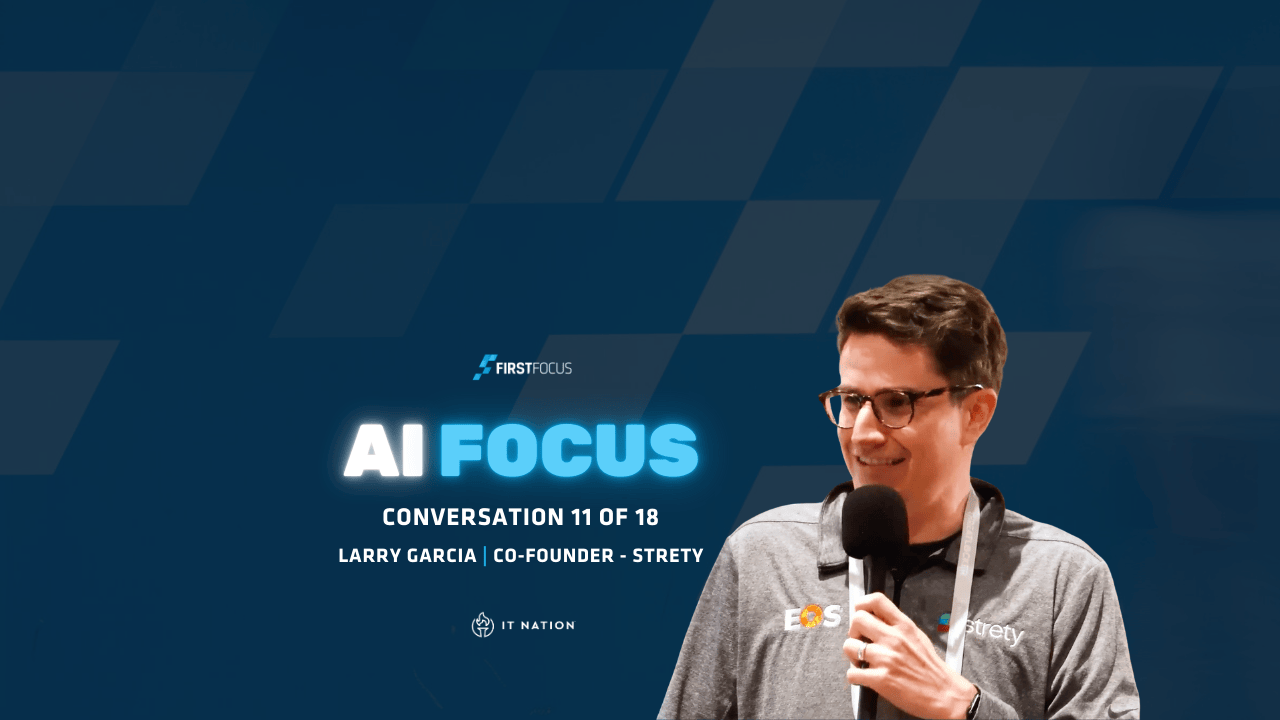
How Strety Uses AI To Accelerate Product Development And Navigate The Hype Cycle
In this AI Focus episode recorded at IT Nation Connect in Orlando, Brendan Ritchie speaks with Strety co-founder Larry Garcia about how AI is transforming product development, planning workflows, and engineering efficiency. Larry shares real examples of how tools like ChatGPT and Claude support his daily work, how Strety integrates AI to enhance their own platform, and why business leaders should stay informed during this noisy period of rapid AI expansion. These lessons are highly relevant for Australian organisations working through their own digital transformation journeys.
Key takeaways
- ChatGPT and Claude serve different strengths and can be used together for better results.
- ChatGPT works well as an all round assistant while Claude supports deeper reasoning and analytical tasks.
- Strety uses AI inside its own application to help customers create quarterly goals more effectively.
- Leaders should stay informed about AI rather than sitting out the hype cycle.
- Some AI valuations are inflated but the long term trajectory of the field remains strong.
- AI is likely to evolve into a supportive advisory layer similar to Jarvis in Iron Man.
- Engineering teams can move 20 to 30 percent faster using AI when supported by strong human oversight.
- AI hallucinations remain a risk and require knowledgeable reviewers who can assess accuracy.
- AI has helped Strety accelerate its product roadmap and commercialisation by improving development efficiency.
Watch the episode
Why AI has become a core part of product development
AI has moved far beyond novelty, especially for teams building software platforms like Strety. Larry Garcia describes how he relies on ChatGPT and Claude daily. Each tool offers different strengths, which is why their team uses both depending on the task. ChatGPT acts as an all purpose partner for planning, writing, documentation, research, and idea shaping. It is flexible, approachable, and reliable for general tasks.
Claude excels in deeper reasoning and structured analysis. Larry explains that it performs well in situations that require long form thought, structured interpretation, or academic style reasoning. Many Australian organisations exploring AI will recognise this pattern. The most productive setup is often a combination of tools, not a single model.
How Strety uses AI to streamline quarterly goal setting
One of the strongest examples Larry highlights is how Strety has embedded AI directly into its application. Their customers use the platform to create, refine, and operationalise quarterly goals. AI assists by helping users articulate their intentions, break down goals into actionable parts, and structure plans more clearly.
For Australian businesses working within EOS or similar frameworks, this type of integrated AI brings real value. It is not just automation. It is clarity, speed, and better alignment. Larry emphasises that AI inside Strety is already making measurable improvements in how teams plan and communicate.
Understanding the hype cycle without avoiding the opportunity
A large part of the conversation focuses on the broader industry shift. Brendan asks whether AI is overhyped or whether the excitement is justified. Larry compares the moment to the internet boom of the late 1990s. If you knew that only a handful of companies would emerge as dominant but also knew those companies would shape the next 50 years, you would still study the technology early. The same is true for AI today.
Even if not every vendor survives, learning the fundamentals now keeps organisations ahead of most of the market. It ensures strategic clarity when choosing tools and protects teams from being left behind as capability accelerates.
Separating genuine capability from marketing noise
Larry acknowledges that many companies in the AI space are being valued on branding rather than true capability. Some products are little more than a thin interface that calls an existing large language model through an API. These companies often receive inflated valuations without delivering unique value.
This is an important consideration for Australian organisations evaluating AI vendors. Look for tools that demonstrate engineering depth, domain expertise, and a roadmap that extends beyond repackaging someone else’s model. True organisational value comes from workflow improvement, proprietary insights, and strong product design.
Where AI is heading in the long term
When imagining the future, Larry predicts something closer to Jarvis in Iron Man rather than a dystopian outcome. AI will be ambient, helpful, and ever present, acting as a guide and advisor while humans remain firmly in control. It will process the background complexity, offer recommendations, and support faster decision making.
This aligns with the direction many Australian organisations are taking. AI is not seen as a replacement but as a capability multiplier that helps teams focus more on high value work.
How AI speeds up engineering without removing oversight
Strety originally started as an internal tool for a previous company before being commercialised three years ago. AI has been particularly beneficial in accelerating engineering output during this journey. Larry explains that while AI does not replace skilled developers, it does give them strong momentum.
The team reports that they move 20 to 30 percent faster because repetitive code is generated automatically. Developers still maintain oversight, validate outputs, refine complex logic, and correct hallucinations. This model allows the team to ship features faster without compromising quality. For Australian engineering teams, this is a key takeaway. AI brings speed, but experienced humans maintain accuracy.
The ongoing quirks of AI generated writing
In a humorous detour, Brendan raises his personal frustration about M dashes appearing in AI outputs. Despite configuring custom style guides, they still slip through. Larry agrees and notes that even with extensive instructions, certain formatting behaviours persist.
The point serves as a reminder for all organisations. AI writing tools are fast and capable, but they are not perfect. Human review is essential. Consistency, voice, and clarity still require careful editing, especially when creating public facing content or materials linked to compliance or governance.
Why now is the right time to engage with AI
Larry concludes with a clear recommendation for leaders. Stay engaged with AI and develop a foundational understanding. Waiting for perfect clarity or guaranteed outcomes risks falling behind more proactive organisations. The businesses that start now will build compound advantages as capability improves.
Across engineering, planning, operations, and product strategy, AI is offering meaningful gains. It does not require a major transformation to deliver measurable value. Small, practical use cases often move the needle the fastest.