 IT Consulting
 Cloud Migration Services
 IT Infrastructure Projects
 Business Continuity Planning
 IT Procurement
 Managed IT Services
 IT Support Services
 Managed Cloud Services
 Managed SharePoint Services
 End User Computing
 Unified Communications
 Connectivity
 Virtual CIO
 Offshore Staff Outsourcing (BPO)
 Managed Security Services
 ACSC Essential 8
 Cybersecurity Risk Assessment
 Cloud Backup and Disaster Recovery
 Cyber Security Connect and Protect Program
 IT Strategy
 Microsoft 365 Consulting Services
 Power BI
 Careers
 Awards and Certifications
 Management Team
 Case Studies
 Sell Your IT Business
 Our Commitment to the Environment
 CSAT Charity Donations
 Media Kit
 Sydney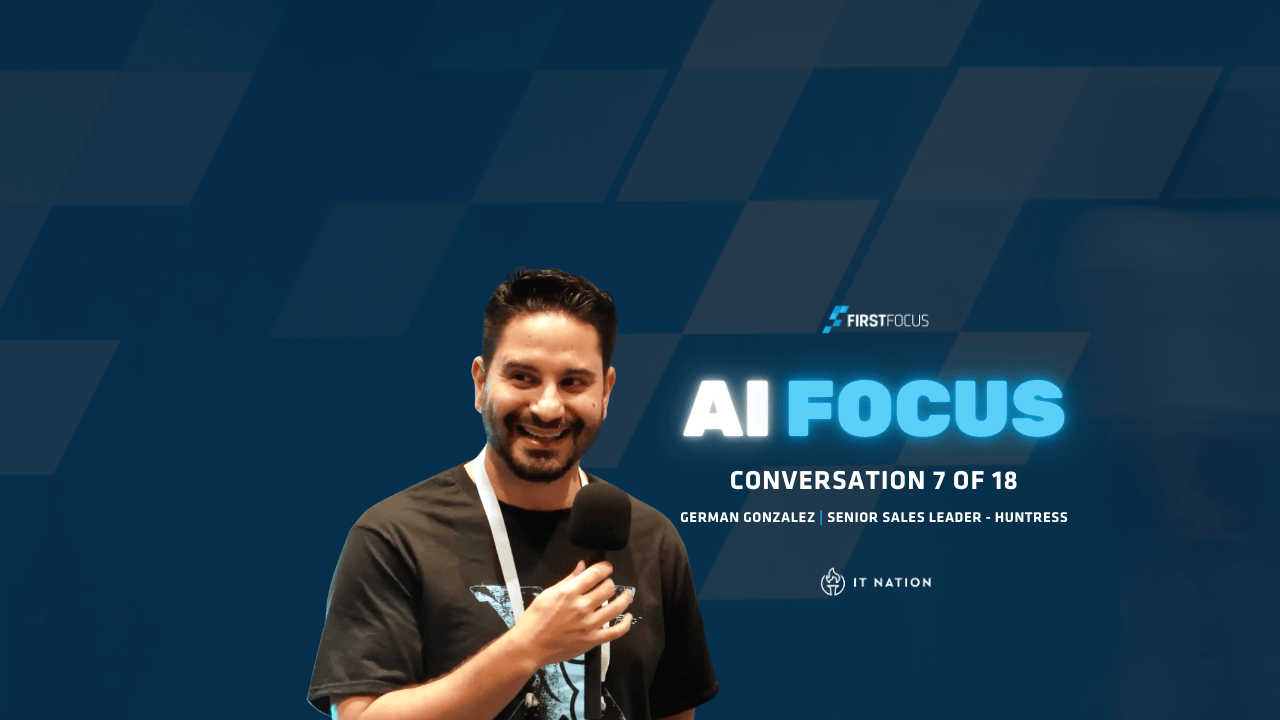
How AI Is Shaping Productivity, Skills and Cybersecurity: Insights from Huntress
In this AI Focus episode, recorded at IT Nation Connect in Orlando, Brendan Ritchie speaks with German Gonzalez from Huntress about how AI is changing productivity, sales operations, cybersecurity and the skills Australian businesses should prioritise. The conversation highlights practical tools, real workflows and the opportunities and risks facing organisations adopting AI today.
Key takeaways
- AI is now embedded across daily sales and operational tasks, saving time and improving accuracy.
- Custom GPTs allow businesses to automate internal workflows, including call summaries and CRM notes.
- Teams increasingly use several AI platforms because each fills a different role.
- Perplexity remains valuable as a curated, unbiased news and research tool.
- Mobile and in-car audio features are becoming essential for AI assisted productivity.
- Security concerns and data governance are still key barriers for many organisations.
- The biggest risk is overtrusting or undertrusting AI, especially with sensitive information.
- Productivity gains may reduce headcount needs, making personal upskilling essential.
- AI rewards people who explore, experiment and build skills outside formal training.
- Free and low-cost tools give individuals the ability to stay relevant if they stay curious.
Watch the episode
Introducing German Gonzalez from Huntress
Brendan opens the discussion by welcoming German Gonzalez, a senior sales leader at Huntress. German explains that Huntress delivers a fully managed cybersecurity platform, including EDR, identity protection, SIM and security awareness training. Everything is backed by their SOC, which provides around-the-clock monitoring and response. For many Australian organisations, this type of managed security model is becoming essential as cyber threats rise and internal capability becomes harder to maintain.
The conversation quickly shifts to AI, where German has become known internally as the person driving adoption and experimentation across the sales organisation.
The AI tools that matter most
German uses several platforms daily. ChatGPT, Gemini and Perplexity each play different roles. While it might seem easier to choose one tool and standardise it, German explains that different models excel in different areas. Google Gemini is used internally because Huntress already maintains a commercial contract with Google, which gives them a safe and supported environment for sensitive information. ChatGPT remains essential for rapid ideation, learning and general queries because it was the platform German originally mastered. Perplexity fills a third gap by providing curated, sourced and less-biased news and research.
Australian IT leaders will recognise this pattern. Many teams are standardising on one enterprise AI tool for governance but still allow staff to explore others for personal productivity. This mixed environment is becoming normal as organisations learn what each platform does best.
Building a custom GPT to solve sales admin pain
One of the most practical insights German shares is the custom GPT he built to generate sales summaries from call transcripts. Huntress already records and transcribes calls, so the missing piece was extracting useful, consistent and accurate notes for CRM entries.
Salespeople often struggle with admin. Notes may be incomplete, inconsistent or simply missing. The custom GPT takes the transcript, identifies the key points and structures them into actionable, ready-to-paste insights for Salesforce. This workflow improvement saves hours each week and ensures the business has more reliable data.
For Australian organisations thinking about AI use cases, this example illustrates an accessible first step. If your team already has recorded meetings, phone calls or Teams sessions, a custom model can summarise, tag and extract structured outcomes. It avoids heavy system integration and starts delivering ROI immediately.
Where Perplexity still stands out
While ChatGPT has improved its ability to cite sources and handle real-time data, German still values Perplexity as a personalised news engine. By setting interests, he receives curated channels across finance, technology and broader global trends. Each item includes summaries, references and the option to play an audio version.
This audio feature is particularly powerful. Many Australian professionals spend hours each week commuting or travelling between client sites. Turning AI curated research into an audio feed transforms downtime into a continuous learning opportunity.
AI on the move: in-car usage and voice integration
Both Brendan and German discuss how often they now rely on AI while driving. ChatGPT’s audio mode has become a personal assistant, delivering company research, customer backgrounds and competitive insights in seconds. This kind of on-the-go intelligence reshapes how professionals prepare for meetings. Instead of reading reports, they learn hands-free through natural conversation.
German also shares that Tesla’s voice assistant now integrates with Grok. This makes spontaneous learning easier, especially for families. His children often ask random questions and instead of guessing, they explore the answer together using an AI that can respond instantly and conversationally.
The challenges of an AI saturated workplace
Despite the excitement, German acknowledges the uncertainties. There are too many tools on the market, causing confusion for new users. People also worry about security and governance, particularly when sharing sensitive business information with AI tools. This is a valid concern for Australian companies facing strict data protection requirements.
Others fall into the opposite trap by oversharing. Uploading confidential documents, customer data or internal strategy into public AI models exposes the organisation to real risk. German emphasises the need for caution and controlled environments.
The trust problem: too little or too much
German notes that a large part of the hesitation with AI comes down to trust. Some users don’t trust the tools at all, limiting their effectiveness. Others trust them too much and hand over data without thinking. Both extremes can cause problems. The right approach sits in the middle and depends on governance, awareness and training.
Productivity gains and their impact on the workforce
A recurring theme across Brendan’s interviews is the link between AI driven productivity and workforce change. As German puts it, if teams become significantly more efficient, businesses may need fewer people to achieve the same outcomes. This is not an immediate shift, but it is a realistic long-term possibility.
This makes upskilling crucial. Individuals who learn to prompt effectively, automate workflows and integrate AI into daily tasks will stay ahead. Those who avoid the technology may struggle to remain competitive in the job market.
- Learn prompting fundamentals.
- Experiment with multiple platforms.
- Follow tutorials and short online courses.
- Use AI for personal tasks to build confidence.
- Adopt a continuous learning mindset.
German reinforces that free and low-cost resources mean there is no real barrier. Anyone can build AI capability if they commit time and curiosity.
Personal responsibility for AI skills
Both German and Brendan share the belief that individuals are responsible for their ongoing development. While businesses can support AI adoption, they can’t train staff on every tool or every scenario. The expectation is shifting. Professionals must stay relevant by investing personal time into learning, just as they would with a university course.
This mindset aligns strongly with the needs of Australian organisations that are moving quickly into automation, cybersecurity uplift and operational efficiency. Staff who proactively build AI fluency will not only keep up but open new career opportunities.
Closing reflections
The conversation closes with a positive outlook. AI is here to stay, and it is improving rapidly. There are risks, but there are far more opportunities for those who learn to use it well. Businesses can lift productivity, strengthen security and unlock new capabilities. Individuals can accelerate their careers by exploring what the tools can do and applying them creatively.
This episode highlights the real-world, practical side of AI adoption: the tools people actually use, the workflows that save time and the skills that matter. For Australian organisations navigating this shift, the message is clear. Start small, experiment widely and build capability early.