For a lot of business leaders, AI still feels like a mix of hype, mystery and vague promises.
You know it is important. You know your competitors are experimenting. But what does practical, day-to-day AI use actually look like for someone who lives and breathes the managed services world?
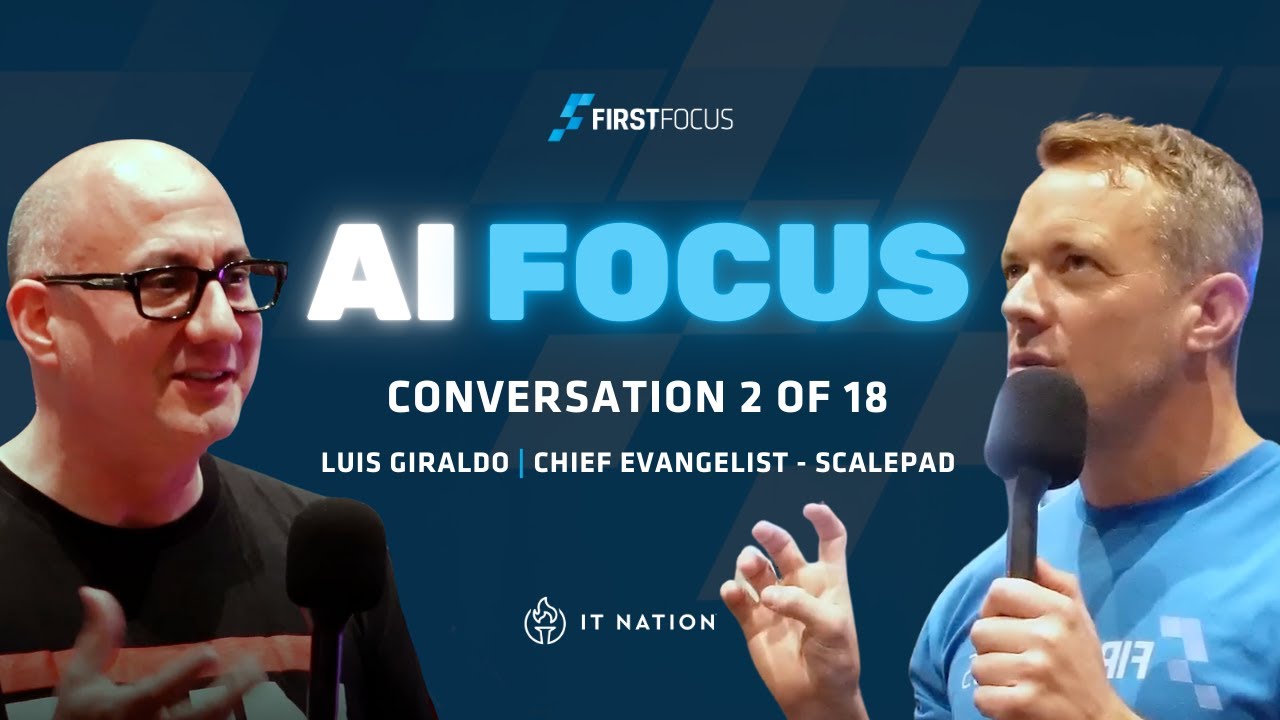
In this episode of AI Focus, filmed live at IT Nation Orlando 2025, Brendan Ritchie (Chief Growth Officer at First Focus) sits down with Luis Giraldo, Chief Evangelist at ScalePad, to unpack exactly that.
Luis is not talking theory. He shares how he personally uses ChatGPT and AI agents every single day, how teams across ScalePad are adopting AI, and why AI fluency might be the real competitive advantage for the next few years.
If you run or lead a mid-sized Australian business, especially in or around the MSP space, this is a very practical look at where AI already fits into real work.
Luis describes his role at ScalePad in a way many business leaders will recognise:
“I am in love with the problem, not the solution.”
As Chief Evangelist, his job is to deeply understand the day-to-day challenges MSPs face, particularly around:
Rather than pushing a particular tool or feature, he spends his time exploring frameworks, ideas and ways to help MSPs make real progress.
AI, and ChatGPT in particular, has become a key part of that exploration.
One of the most interesting ways Luis uses ChatGPT is for framework exploration.
He often spots ideas from completely different industries, like a line in a TV advert for a soap company and wonders:
“If that idea were built for MSPs, what would it look like?”
ChatGPT becomes the thinking partner for that translation work. Luis will feed it the concept and ask it to:
For business leaders, this is a powerful mental model:
Instead of starting from a blank page, you start from “something interesting I saw” and ask ChatGPT to help you adapt it to your world. It is not about copying. It is about using AI to accelerate your own strategic thinking.
Luis also takes advantage of ChatGPT agents and scheduled runs to stay on top of what matters in the MSP world.
Each day, he has ChatGPT:
ChatGPT then delivers a short bullet point report with:
This is a simple but potent pattern for busy leaders:
Instead of manually trawling blogs, feeds and newsletters, Luis gets a curated, always-on briefing tailored to his role.
If AI can summarise anything into ten neat bullet points, are we all just reading less?
Luis acknowledges the risk. Concepts like “work slop” have emerged to describe shallow, AI-assisted output that looks like work but does not reflect deep thinking.
His way through it is to use AI as an unblocker, not a replacement for thinking.
For example:
The key distinction is intent. If you are using AI to avoid thinking, your work will slide into slop. If you use AI to get started faster and then apply your own judgement and experience, you can move more quickly without sacrificing quality.
ChatGPT is not just a “Luis thing” at ScalePad. It is available to any team member who wants to use it, with different departments adopting it in ways that fit their workflows.
Some examples Luis shares:
Importantly, these uses are not “set and forget”. Human review remains central, but AI speeds up the first 30 to 50 percent of the work.
For Australian mid-market organisations, this is a helpful template: you do not need one huge AI project. You can enable teams to adopt AI incrementally where it removes friction.
Slide creation is another area where Luis has found real value.
ScalePad uses a tool called Gamma to create presentation decks. Gamma can be incredibly powerful when it is fed the right brand information and structured prompts, but getting those prompts right is not always straightforward.
Luis’s solution:
Use ChatGPT to generate prompts for Gamma.
He gives ChatGPT the context (brand guidelines, audience, purpose of the deck) and asks it to produce a Gamma-ready prompt that:
In other words, AI helps him talk to AI more effectively.
For any business using multiple AI tools, this pattern is worth stealing: let one AI help you structure the inputs for another.
Despite all the progress, Luis believes the biggest barrier to meaningful AI adoption is simple:
People do not know what the tools they already have can do.
From Grok in a Tesla, to camera-based features in ChatGPT, to AI-powered shortcuts hiding in everyday apps like Slack, there is a growing gap between what is available and what most people are actually using.
This is where AI fluency comes in.
AI fluency is not about becoming a machine learning expert. It is about:
Leaders who cultivate AI fluency across their teams will see far greater returns from the tools they are already paying for.
One of the most charming parts of the conversation is Luis’s story about teaching his mum to use ChatGPT Vision.
She is naturally curious and often wonders out loud:
Luis showed her how to:
Suddenly, she was walking around taking photos and getting rich, contextual answers about the world around her.
It might seem like a small, almost silly example, but it perfectly captures how confidence and curiosity can turn everyday AI features into something genuinely empowering.
For your staff, the “trees and birds” might be:
The principle is the same: show them one or two simple, relevant use cases and let fluency build from there.


 IT Consulting
 Cloud Migration Services
 IT Infrastructure Projects
 Business Continuity Planning
 IT Procurement
 Managed IT Services
 IT Support Services
 Managed Cloud Services
 Managed SharePoint Services
 End User Computing
 Unified Communications
 Connectivity
 Virtual CIO
 Managed Security Services
 ACSC Essential 8
 Cybersecurity Risk Assessment
 Cloud Backup and Disaster Recovery
 Cyber Security Connect and Protect Program
 IT Strategy
 Microsoft 365 Consulting Services
 Power BI
 Awards and Certifications
 Management Team
 Our Commitment to the Environment
 CSAT Charity Donations
 Media Kit
 Sydney