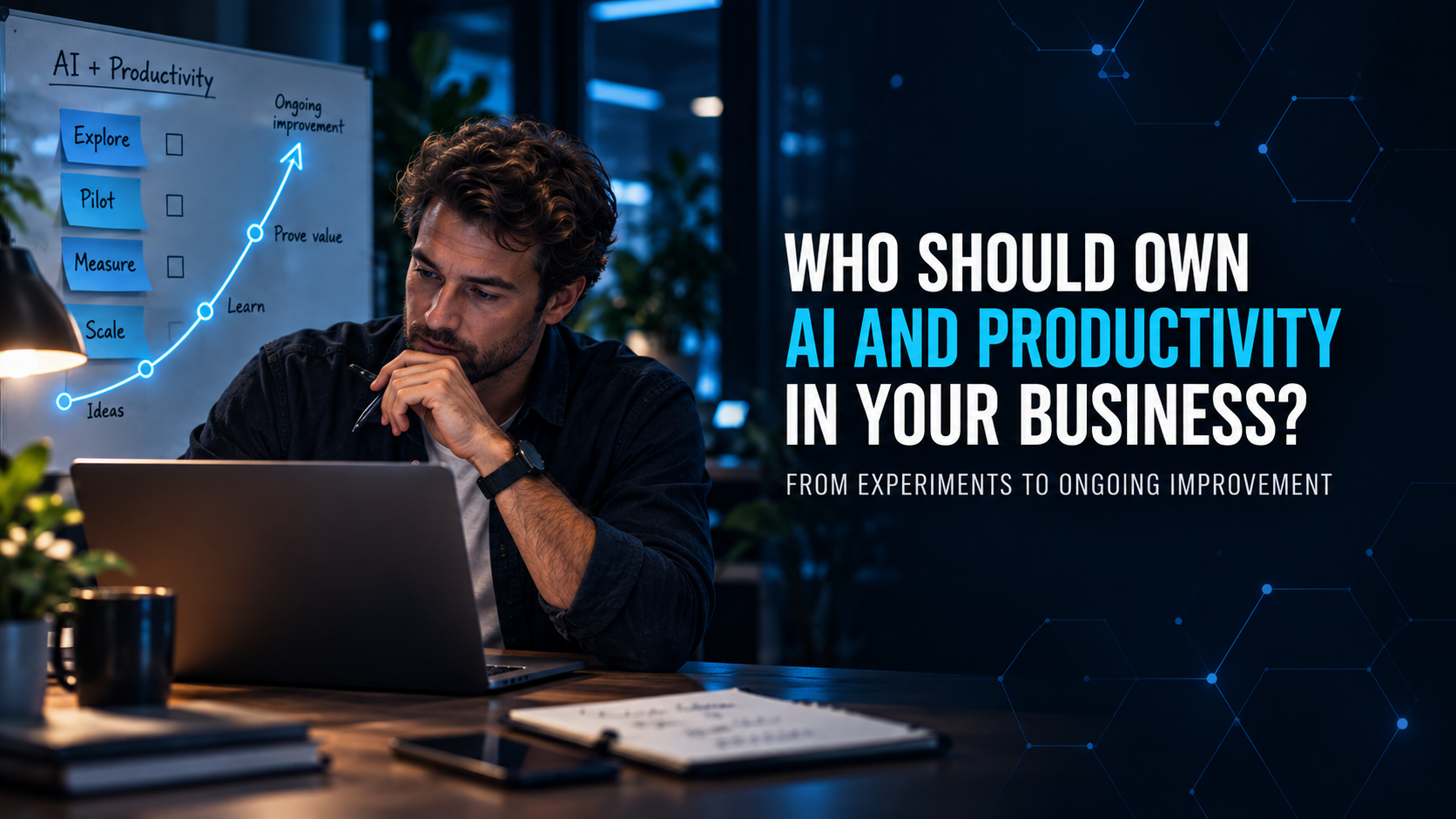
Most small businesses feel the same squeeze. The workload keeps growing, but adding people is slow and expensive, and more headcount does not always fix the problem. AI looks like a way through. The harder question is whether it changes anything once the novelty wears off.
The difference is rarely the tool. It comes down to tying AI to a clear business outcome and putting the right support around it. Shamrock, a product development business, is a good example of a team that worked this out and turned it into results.
Tie AI to a business outcome before you start. Shamrock set targets around return and hours saved, not a tool rollout.
A capable team can still hit limits going it alone. The blockers are usually security and support, not ambition.
Productivity can stand in for headcount. Shamrock grew output without growing the wage bill.
Speed is the visible win. Concepts that used to take days now take hours.
Use a return benchmark. First Focus looks for around 2.8 times return in the first twelve months.
Judge the work by the accounts, not by how the tools feel to use.
Choose a partner who is accountable for the outcome, not just a product that leaves you to work out the rest.
Shamrock works in the craft market, where trends move fast.
You have three to six months to get a product into a retailer and selling. After that, the trend just gets shut off
~ Louisa Mguni
That pace rewards speed and punishes waste. Rather than hiring to keep up, the team made a sharper commercial call. For a small business, every new role adds cost and pressure before it adds capacity. So, Shamrock backed productivity instead and looked to AI to get more done with the people they already had. That decision set up everything that followed.
Shamrock was already moving on AI before most businesses its size. One of the team’s accountants was building her own agents and connecting them to company systems to take work off her plate. That is real initiative, and it put her ahead of the curve.
She also asked the right questions early. Could confidential information end up somewhere it should not? Were the agents actually doing the job? And who do you turn to when something breaks?
It was just me and the AI tool.
~ Louisa Mguni
Those are exactly the questions that separate buying AI from getting a result from it. Shamrock saw them coming, which is why the next step worked.
What changed was the support around the work, not the team’s ambition. With governance and security in place, Shamrock’s people could test ideas freely without putting company data at risk. When something needed troubleshooting, help was there. One of First Focus’s commitments is to never leave an environment in a worse state than it was found, so the team could be curious with confidence.
That foundation, the data governance, security, training, and ongoing support wrapped around the AI, is what First Focus delivers through a service called CORE. It gives a team that capability without having to assemble it piece by piece.
The pace of the business showed in how quickly the team ran with it. Shamrock’s CEO was working on a concept on a Saturday, hit a question, and reached out. He got a response that weekend.
He came in on Monday just so excited, telling everyone about it.
~ Louisa Mguni
The day-to-day work sped up too. Concepts that used to take days now take hours. The CEO can hand a graphic designer an idea that is already 80 percent built, so the designer finishes the last 20 percent instead of starting from a long briefing. Support requests that once dragged on were getting resolved quickly. All of it came from the same team, working faster.
The part that matters most to a commercially minded reader is how Shamrock judged the work. AI was never rolled out for its own sake. It was measured on return and hours saved each month from the start. A useful benchmark First Focus uses is around 2.8 times return in the first twelve months. If a piece of work cannot get there fairly easily, it is not the one to chase.
The proof showed up in Shamrock’s accounts.
The only reason we turned it around is that the team improved productivity, so we could scale without increasing our headcount. The directors saw that in the profit.
Shamrock’s accountant
For an accountant who has to justify the spend in the room, being able to point to the return made the case for her.
The clearest part of Shamrock’s story is that the win came from a relationship, not a single tool. A product gives you software and leaves you to work out the rest. A partner takes responsibility for the outcome: keeping things secure, training your people, fixing what breaks, and tying the work to numbers you can stand behind. Shamrock chose a partner, and it changed how the business uses technology day to day.
AI can do for a small team what extra headcount used to. It works when it is connected to real outcomes, supported by people who know what they are doing, and kept safe along the way.
If your team is feeling the same pressure to do more without hiring, the place to start is not a tool. It is a clear view of where AI could pay off in your business, and a plan to get there safely. First Focus brings the AI, automation, security, data governance, training, and support together as one partnership through CORE. Get in touch to talk through what it could do for your team.

 IT Strategy
 IT Consulting
 Data Services
 IT Infrastructure Projects
 IT Procurement
 Business Continuity Planning
 Virtual CIO
 Cloud Migration Services
 Managed IT Services
 IT Support Services
 Managed Cloud Services
 Managed SharePoint Services
 Unified Communications
 Connectivity
 Offshore Staff Outsourcing (BPO)
 Managed Security Services
 ACSC Essential 8
 Cybersecurity Risk Assessment
 Cloud Backup and Disaster Recovery
 Cyber Security Connect and Protect Program
 Automation
 Power BI
 Careers
 Awards and Certifications
 Management Team
 Case Studies
 Sell Your IT Business
 Our Commitment to the Environment
 CSAT Charity Donations
 Media Kit
 Sydney