 IT Consulting
 Cloud Migration Services
 IT Infrastructure Projects
 Business Continuity Planning
 IT Procurement
 Managed IT Services
 IT Support Services
 Managed Cloud Services
 Managed SharePoint Services
 End User Computing
 Unified Communications
 Connectivity
 Virtual CIO
 Offshore Staff Outsourcing (BPO)
 Managed Security Services
 ACSC Essential 8
 Cybersecurity Risk Assessment
 Cloud Backup and Disaster Recovery
 Cyber Security Connect and Protect Program
 IT Strategy
 Microsoft 365 Consulting Services
 Power BI
 Careers
 Awards and Certifications
 Management Team
 Case Studies
 Sell Your IT Business
 Our Commitment to the Environment
 CSAT Charity Donations
 Media Kit
 Sydney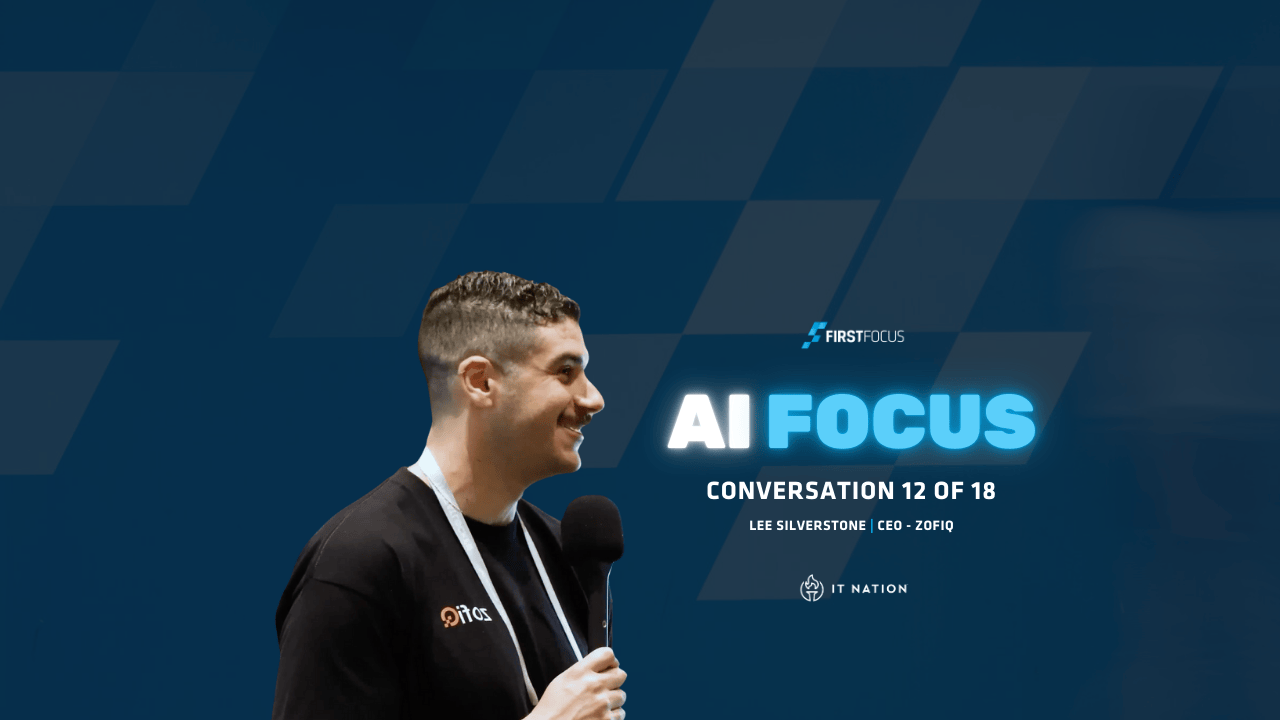
How AI-Driven Automation Is Transforming MSP Operations with zofiQ
At IT Nation Connect in Orlando, Brendan Ritchie sat down with Lee Silverstone, co-founder and CEO of zofiQ, to explore how AI automation is reshaping managed services. Their discussion offers practical insights for Australian MSPs looking to reduce ticket noise, speed up triage and dispatch, and adopt AI tools that create real operational impact rather than hype.
Key takeaways
- AI automation is moving from theory to practical deployment across MSP service desks.
- zofiQ enables MSPs to deploy AI agents for triage and dispatch in under an hour.
- AI learns from historical ticket data rather than relying on manual workflow builds.
- High growth in AI products is driven by strong community feedback loops.
- Quality matters as much as speed; building agentic systems is more complex than many assume.
- Misuse of the term “AI” has become a major industry frustration for leaders building serious tools.
- AI co-pilots can significantly accelerate technician resolution times when tickets require human input.
- MSPs benefit most when AI reduces repetitive work and allows technicians to focus on value-added tasks.
Watch the episode
AI adoption is accelerating for MSPs
Brendan opened the conversation by asking Lee Silverstone to introduce himself and outline the role of zofiQ. As a co-founder and CEO, Lee leads a platform focused on AI-driven automation for MSPs, covering service ticket creation, triage, dispatch and guided resolution. The goal is simple. Reduce operational drag and allow busy service teams to work faster with fewer manual steps.
For Australian MSPs under pressure to maintain service levels while managing rising labour costs, this shift toward automation aligns strongly with the local market. Highly manual ticket queues, inconsistent triage practices and long resolution times create unnecessary strain. AI tools that free technicians from repetitive work are becoming essential rather than optional.
Why AI-driven triage matters
One of the standout themes from the interview is how quickly AI can now be deployed for meaningful operational improvement. Lee shared that zofiQ’s AI agents can take over triage and dispatch within one hour. Most platforms require days or weeks of setup.
Instead of building workflows manually, the AI trains itself on historical ticket data. This allows it to understand patterns, actions, priorities and next steps that technicians have taken over time. For MSPs with years of service history, this creates a fast onramp to improvement.
- No workflow mapping.
- No rules-based configuration.
- No guesswork from technicians or consultants.
The AI models the MSP’s real behaviour and applies it consistently, removing bottlenecks created by manual classification. For a service desk handling thousands of tickets, small increases in accuracy create significant gains in efficiency and customer satisfaction.
Building impactful AI products is not simple
Brendan asked Lee what he enjoyed and disliked about the current AI landscape. The answer was refreshingly honest. Despite assumptions that AI makes it easier to build software, Lee believes the opposite is true. Creating robust agentic systems requires deep engineering capability, strong data foundations and constant iteration.
This observation aligns with what many Australian IT leaders are experiencing. It is easy to experiment with generic AI tools. It is far more complex to build secure, predictable and enterprise-ready automation for environments that demand reliability.
Two frustrations stand out for Lee:
- Vendors misusing the term AI for basic LLM features.
- The idea that AI reduces the effort required to build high-quality software.
These issues can confuse customers and make it harder for MSPs to cut through the noise when evaluating new platforms.
The role of community in scaling AI solutions
zofiQ’s rapid growth has been heavily shaped by the MSP community. Lee shared that this is the fastest-growing company he has built, largely because partners are willing to share their operational challenges and participate directly in solution design.
For MSPs, this reinforces the importance of selecting tools that evolve through real-world feedback rather than theoretical product roadmaps. Tools designed in close partnership with service leaders tend to fit operational needs more naturally.
AI co-pilots and the future of ticket resolution
While triage and dispatch automation deliver major value, Lee also highlighted how AI supports technicians when a ticket does require manual work. zofiQ provides a co-pilot that helps technicians solve problems faster by offering context, recommended actions and guidance drawn from historical cases.
For Australian MSPs where technician time is one of the most constrained resources, this type of augmentation improves throughput without hiring additional staff. Co-pilots reduce time spent searching documentation or repeating previous solutions and help newer technicians ramp up more quickly.
Why AI quality will matter more in 2025
As the AI market expands, MSPs face a growing challenge. There are more tools claiming to offer automation than ever before, but not all are built on solid engineering foundations. Lee’s comments highlight why evaluation criteria need to mature.
Key considerations for MSPs include:
- Does the AI learn from real historical data?
- How fast can the platform be implemented?
- Is there visibility into decisions and outcomes?
- Does the AI reduce technician workload in measurable ways?
- Is the vendor transparent about the types of models used?
Focusing on outcomes rather than labels helps ensure MSPs invest in tools that create real operational change. This is particularly important in Australia, where MSPs often run lean teams across broad customer portfolios.
Clear benefits for Australian businesses adopting AI automation
Australian MSPs support a wide mix of industries, from healthcare and retail to construction and professional services. Each sector has distinct pressures and service expectations. AI automation helps MSPs meet those expectations consistently while improving internal operations.
Some of the benefits that align closely with the Australian market include:
- Reducing technician burnout by removing repetitive triage tasks.
- Improving SLA performance with faster ticket routing.
- Supporting regional teams that may have limited staffing.
- Creating more predictable customer experiences.
- Scaling service quality without increasing payroll costs.
These outcomes increase competitiveness in a market that places strong value on service reliability and transparent performance.
Building AI capability through practical adoption
Many Australian businesses still feel cautious about AI, even as interest grows. Conversations like this one help demystify what AI tools can achieve today without major transformation projects. The focus is on practical, incremental wins rather than abstract concepts.
By deploying AI to solve specific operational challenges, MSPs can build internal confidence and lay the foundation for broader automation. This approach ensures teams see value early and understand how AI can support their work rather than replace it.
Wrapping up
Brendan’s discussion with Lee Silverstone highlights how rapidly AI automation is maturing for MSPs. Tools like zofiQ show what is possible when AI is grounded in strong engineering, real-world data and ongoing community input. For Australian MSPs exploring automation, this episode provides clear direction on what good AI looks like and why quality matters more than ever.