 IT Strategy
 IT Consulting
 Data Services
 IT Infrastructure Projects
 IT Procurement
 Business Continuity Planning
 Virtual CIO
 Cloud Migration Services
 Managed IT Services
 IT Support Services
 Managed Cloud Services
 Managed SharePoint Services
 Unified Communications
 Connectivity
 Offshore Staff Outsourcing (BPO)
 Managed Security Services
 ACSC Essential 8
 Cybersecurity Risk Assessment
 Cloud Backup and Disaster Recovery
 Cyber Security Connect and Protect Program
 Automation
 Power BI
 Careers
 Awards and Certifications
 Management Team
 Case Studies
 Sell Your IT Business
 Our Commitment to the Environment
 CSAT Charity Donations
 Media Kit
 Sydney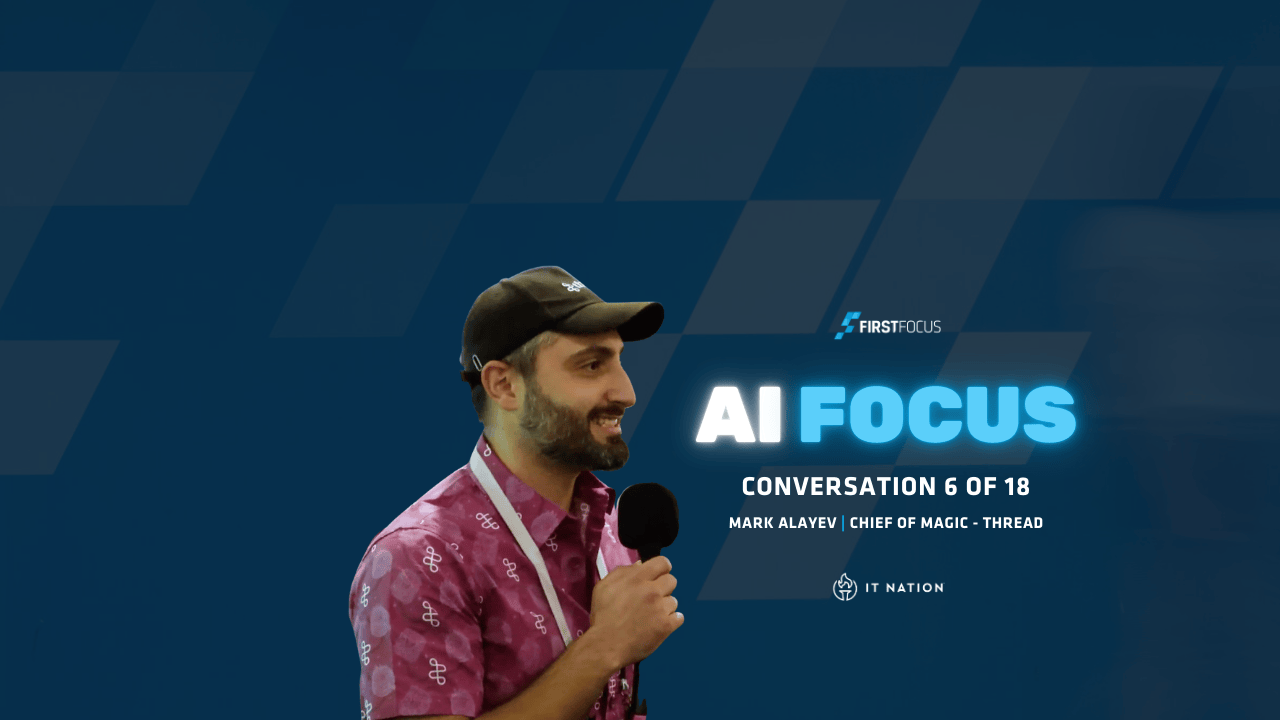
How AI Tools Are Transforming MSP Operations and Real-Time Troubleshooting
This episode of AI Focus was recorded live in Orlando at the IT Nation Connect Global Conference, where Brendan Richie sat down with industry expert Mark Alive, Chief of Magic at Thread. Their conversation dives into the rapid evolution of AI tools, how MSPs can use them to streamline operations, and why new capabilities like browser automation and real-time visual troubleshooting are reshaping what service teams can achieve. The discussion gives Australian businesses a clear view of where AI is headed and how these tools can improve service delivery, speed, and consistency.
Key takeaways
- AI tools are moving beyond text responses and now support real-time visual troubleshooting.
- Data-gathering tools like Mattis can crawl the web, source contacts, and create ready-to-use spreadsheets.
- Browser-based AI interfaces can perform repetitive operational tasks with accuracy and speed.
- MSPs can automate invoice reconciliation, research, and documentation using modern AI tools.
- AI’s value increases when paired with a clear business superpower such as communication or workflow insight.
- Advanced audio and camera features in ChatGPT simplify complex technical support tasks.
- Rapid tool proliferation means most MSPs still underuse the capabilities they already have.
- Consistency and speed are the biggest AI-driven performance gains for service teams.
- AI expands job opportunities by removing manual work, not replacing meaningful roles.
- MSPs leveraging AI can deliver same-day SLAs with confidence and reliability.
Watch the episode
AI tools that go beyond text
Brendan opens the conversation by asking Mark about his favourite AI tools and the most impressive things he has built with them. While Thread’s own platform is a natural talking point, Mark instead shines a light on new tools that MSPs and technical teams can adopt today.
One of his standouts is Mattis, a tool designed to work with spreadsheets and documents. It can crawl the web and assemble structured datasets within minutes. For example, if someone needs a list of dental clinics in a particular region with specific staffing levels, Mattis can search, verify details, and generate a spreadsheet that includes names, contact details, practitioner counts, and more. It handles tasks that once took hours of manual research, making it ideal for MSP business development, market analysis, and account planning.
This is especially relevant in Australia where MSPs compete across diverse regional markets. Tools like Mattis help providers assess opportunities, build outreach lists, and prepare proposals quickly without tying up technical or sales staff.
Real-time visual troubleshooting using mobile AI
Another standout capability is the advanced audio mode in ChatGPT for mobile. When enabled, it presents a small camera icon. Mark explains how this allows real-time visual troubleshooting. By pointing the camera at a device, cabling layout, or network appliance, the system can identify components, suggest fixes, and guide the user step by step.
For MSPs with clients across Australia’s remote and regional locations, this is significant. It transforms how support teams handle onsite dispatches. Instead of relying solely on technician notes or delayed photos, a service desk analyst can guide troubleshooting live through the technician’s device and diagnose issues accurately.
- Technicians can show the back of a router or firewall.
- The AI can identify ports and connections in real time.
- The system can provide immediate next steps based on what it sees.
This reduces wasted time, improves first-time fix rates, and helps MSPs maintain consistent delivery quality even when different levels of technicians are in the field.
AI adoption is accelerating faster than most can keep up with
Brendan reflects on how, only a year ago, real-time audio and visual AI tools were a novelty. During a peer group session, an AI consultant demonstrated similar functionality that shocked the room. Now it sits inside the standard ChatGPT mobile app, available to anyone with a premium account.
This shift shows how quickly AI is embedding itself into everyday workflows. Yet many professionals remain unaware of features that could significantly reduce their workload. As Brendan puts it, users often discover new capabilities only by accident because the pace of change is so fast.
This is one reason Thread hosts its weekly AI Service Unleashed calls, where they gather emerging AI news, test new tools, and demonstrate real use cases for MSPs. Mark explains that he uses Mattis and ChatGPT’s browser tools to gather the latest updates and summarise practical applications for technical leaders, service delivery managers, and operations teams.
Browser-based AI enhances operational tasks
One of the most transformative updates discussed is the ChatGPT browser version. Unlike traditional prompt-based interactions, the browser-enabled interface allows the AI to interact with web pages directly. It can click, scroll, download, extract, and manipulate content in the same way a person would.
For MSPs, this capability solves tedious repeatable tasks such as invoice reconciliation. Mark outlines a real scenario:
- Log in to a vendor portal.
- Access all monthly invoices.
- Open each invoice automatically.
- Extract amounts and line items.
- Return the data as a clean table ready for billing reconciliation.
This removes manual work that previously consumed hours. For finance teams and service managers, this is a powerful shift. The AI can act as an assistant that executes tasks accurately and consistently, reducing the risk of human error.
Brendan highlights that he plans to test the browser version on his long trip home from the United States. Like many MSP leaders, he sees the potential to automate repetitive operational processes across finance, service delivery, procurement, and reporting.
Why AI needs tools, eyes, and hands
When asked why AI needs browser functionality, Mark explains that large language models can reason, predict, and analyse but need extensions to interact with systems. Giving the model a browser is similar to giving it a pair of hands and a set of eyes. With access to the camera, it can interpret visual information. With browser access, it can act on that information.
This layered capability enables end-to-end automation. The model can:
- Assess information.
- Decide the next action.
- Execute tasks through the browser.
- Report outcomes back to the user.
For MSPs, the practical benefit is straightforward. AI can now complete work that was previously too process-heavy to automate without expensive custom development.
Thread’s journey and the importance of communication as a superpower
While Thread now plays a major role in AI service desk innovation, Mark explains that the company existed before the generative AI boom. Originally launched as Chat GD, the platform focused on enhancing communication between MSPs and clients through chat-driven workflows.
When generative AI emerged, Thread was well placed to take advantage of it because strong communication was already their core capability. Their system could read conversations, prioritise tickets, classify issues, and respond to clients consistently. AI did not replace their original value proposition. Instead, it amplified it.
Mark recommends that any business exploring AI consider their unique angle. AI alone is not a differentiator. Success comes from pairing AI capability with a specific superpower, whether that is communication, workflow insight, industry knowledge, or customer experience.
AI improves job quality, not replaces it
The conversation moves into whether Thread’s growth reflects broader job creation opportunities in the AI era. Mark believes the industry is gaining more than it loses. AI removes manual tasks that no one enjoys, such as reclassifying tickets, moving priorities around, or transcribing conversations. This frees technicians and service teams to focus on meaningful work, problem-solving, and client relationships.
For MSPs in Australia, this is particularly valuable. Tight labour markets and the high cost of technical talent mean that teams need to spend their time on tasks that truly drive outcomes. AI makes that possible by absorbing the administrative load.
AI enables consistency and faster delivery for MSPs
Brendan notes that First Focus has already seen the impact of AI-driven service desk workflows. Instead of traditional P1–P4 prioritisation ladders that dragged out response times, the organisation has moved to same-day SLAs for 90 per cent of tickets. The clarity provided by AI classification and routing ensures nothing gets stuck, overlooked, or mishandled.
He emphasises that clients appreciate the consistency most of all. AI supports technicians with accurate classification, detailed summaries, and reliable recommendations, which helps the team deliver outcomes faster and with fewer mistakes.
As Brendan puts it, AI removes manual work that does not contribute to a technician’s life’s work. Instead, it elevates both the employee and the client experience.
The future of AI in MSP operations
The conversation ends with a shared sense of excitement about what the next year will bring. With browser automation, real-time visual support, and intelligent task execution now available through mainstream tools, MSPs have more capability at their fingertips than ever before.
Australian organisations that embrace these advancements will gain operational speed, stronger SLAs, and better client outcomes. Those who hesitate risk falling behind as competitors use AI to reduce costs, increase accuracy, and strengthen service delivery.
AI Focus will continue to explore these developments and speak with the leaders shaping the next stage of AI-enabled MSP operations.