 IT Consulting
 Data Services
 IT Infrastructure Projects
 IT Procurement
 Business Continuity Planning
 Cloud Migration Services
 Managed IT Services
 IT Support Services
 Managed Cloud Services
 Managed SharePoint Services
 End User Computing
 Unified Communications
 Connectivity
 Virtual CIO
 Offshore Staff Outsourcing (BPO)
 Managed Security Services
 ACSC Essential 8
 Cybersecurity Risk Assessment
 Cloud Backup and Disaster Recovery
 Cyber Security Connect and Protect Program
 Automation
 IT Strategy
 Microsoft 365 Consulting
 Power BI
 Careers
 Awards and Certifications
 Management Team
 Case Studies
 Sell Your IT Business
 Our Commitment to the Environment
 CSAT Charity Donations
 Media Kit
 Sydney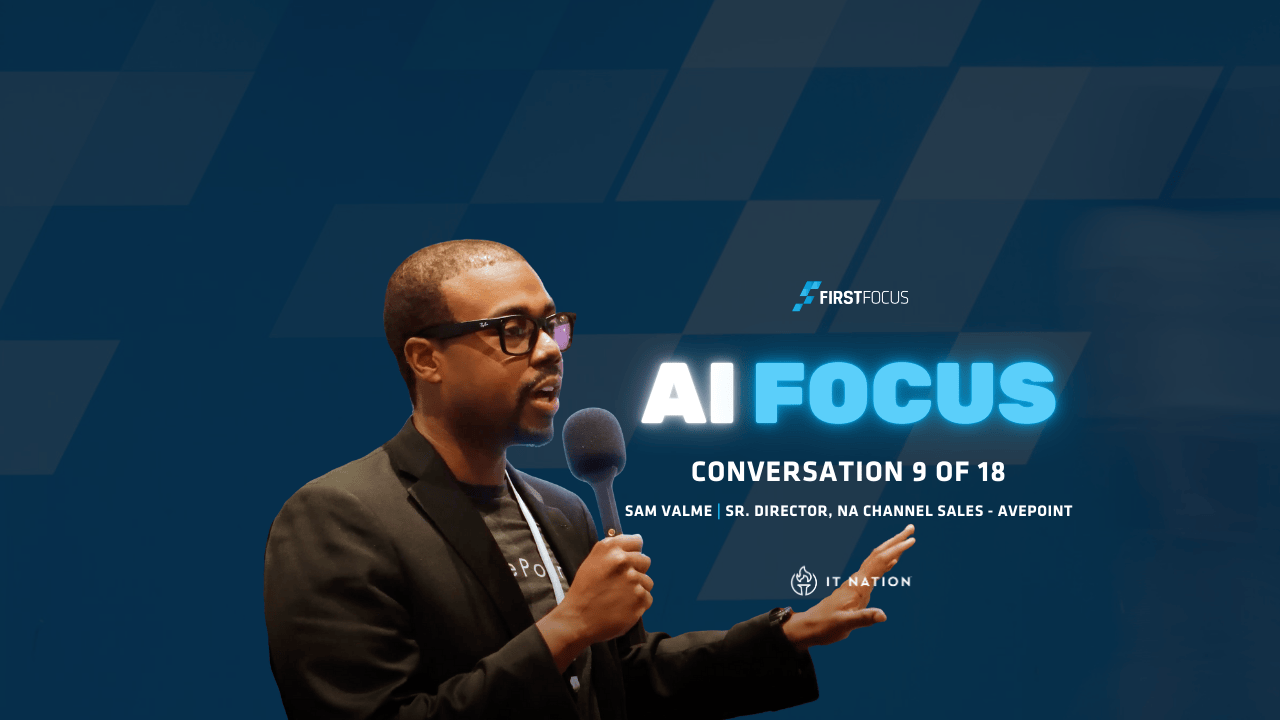
Why Good Data Governance Determines Your AI Success: Insights from AvePoint’s Sam Valme
In this AI Focus episode filmed at IT Nation Connect in Orlando, Brendan Ritchie sits down with Sam Valme, Senior Director of North America Channel Sales at AvePoint, to unpack why data governance, security, and preparation matter more than ever for Australian businesses adopting AI. Sam works closely with MSPs across the United States and Canada, helping them strengthen their data foundations so AI investments deliver real value. His perspective offers clear lessons for organisations across Australia looking to maximise AI outcomes while avoiding governance and security pitfalls.
Key takeaways
- Strong data governance remains the foundation of every AI initiative.
- AI is exposing long-standing data security issues that have always existed.
- Good data leads to good AI outcomes, especially across M365 and SharePoint.
- Copilot Studio can automate meaningful competitive and market intelligence.
- Account-based AI agents provide richer insights than broad buyer-intent tools.
- AI can help MSPs identify data security gaps in seconds by exposing risky access.
- Businesses should treat AI readiness as a continuation of long-term governance work.
- MSPs can use AI-powered battle cards and research to improve sales effectiveness.
- The rapid pace of AI change is creating clarity around what “good” data looks like.
- AI empowers MSPs to demonstrate confidence and credibility around security.
Watch the episode
The accelerating AI shift is exposing long-standing data problems
Brendan opens the conversation with a simple question about Sam’s work at AvePoint, and the answer sets the tone for the entire episode. Sam explains that his team supports MSPs across North America on the full data security journey. For years the focus has been on preparing environments for new waves of technology. Whether it was Dell solutions in previous years or SharePoint transformations before that, the core requirement has never changed. A business can only adopt new tools if its data foundation is solid.
In today’s rapidly evolving market, the headline shift is AI. But Sam is clear that the underlying challenge has remained the same. Data governance and security are not new concerns. The difference is that AI, particularly tools like Microsoft Copilot, is now revealing issues that have been hidden for years. When users can instantly ask Copilot to find sensitive data or discover unknown access pathways, weaknesses become obvious. The technology simply shines a light on what already existed.
For MSPs across Australia, this message is timely. Many businesses are racing to integrate AI into M365, SharePoint, or internal workflows. But without the right foundations, the results will fall flat. Good AI outcomes always start with good data.
Why unstructured data is the biggest challenge for AI readiness
Sam highlights unstructured data as the main barrier to effective AI adoption. This includes the documents, chats, files, emails, and collaborative content inside M365 and SharePoint. While structured systems often have solid governance controls, unstructured environments grow rapidly and organically. That makes it harder to maintain visibility and control.
AvePoint’s technology helps MSPs prepare these environments so Copilot, search functionality, and future AI models can interpret and use the data safely. When an environment is structured well, MSPs gain two clear benefits:
- They can confidently demonstrate security maturity to customers.
- They can accelerate AI adoption without exposing risk.
The takeaway for Australian MSPs is simple. AI investment should not begin with prompting or automation tools. It should begin with data classification, governance, and the right policies across M365.
A practical example: Using Copilot Studio to build targeted research agents
One of the most interesting parts of the conversation is Sam’s personal use of AI. As a senior sales leader, he built a competitive intelligence agent inside Copilot Studio. This tool runs every day, scans the market, checks for acquisition activity, and reviews updates from known competitors and key partners.
This is a good example of how business leaders can automate narrow, high-value workflows. Sam explains that the agent only works because he fed it high-quality information. He provided:
- A list of competitors and profiles.
- Signals and trends to monitor, such as governance acquisitions.
- Partner lists and account-based indicators.
- Context around the type of changes that matter to AvePoint.
The agent then produces a daily report, helping his team stay sharp and informed. It also assists with building battle cards and refining vertical-specific messaging for MSPs.
How this approach compares to tools like ZoomInfo
Brendan raises a useful question. If everyday users can now build custom research agents, does this disrupt broader buyer-intent platforms such as ZoomInfo? Sam doesn’t think so. Those tools still play a valuable role for broad, top-of-funnel discovery when organisations may not know who they’re trying to reach.
The power of AI agents lies in specificity. They excel when the business already understands its accounts, competitors, or verticals. In those situations, AI becomes an augmentation tool, delivering faster, account-based insights without the overhead of manual research.
This is a strong reminder for Australian MSPs and IT leaders that AI is not replacing strategy. It is amplifying it. Good inputs still drive good outcomes.
AI is forcing businesses to confront data issues they ignored for years
When asked what he dislikes about the AI moment, Sam is straightforward. He dislikes the misconception that data security has suddenly become important. These issues have always existed. Organisations are only becoming more aware of them because AI is making the visibility problem disappear.
However, he also sees this exposure as a major positive. MSPs can now show customers exactly where sensitive information is stored, who can access it, and whether it aligns with their security expectations. This visibility allows MSPs to confidently stand behind their governance practices and demonstrate measurable value.
For Australian organisations under growing compliance pressures, this transparency is invaluable. It supports stronger risk management, more efficient audits, and smoother AI adoption pathways across the business.
AI brings new clarity, faster insights, and stronger customer confidence
The pace of AI change is intense. But Sam views this positively. He believes AI gives MSPs an opportunity to take long-running governance conversations and make them real. With Copilot and similar tools, customers can see for themselves whether their environments are secure.
This reduces uncertainty and builds trust. When MSPs can show clear evidence of data governance maturity, it strengthens their relationships and positions them to lead clients into the next stage of AI transformation.
A global conversation with familiar humour
The episode closes with a light-hearted exchange about accents, cultural quirks, and the similarities between Australians and Kiwis. While playful, it reinforces the global nature of the AI conversation. Regardless of location, MSPs in Australia, New Zealand, the United States, and beyond are dealing with the same challenge. They are trying to align rapid AI opportunity with long-term data governance foundations.
That alignment is where the true value lies. Businesses that invest in governance today will access far stronger AI outcomes tomorrow.