 IT Consulting
 Data Services
 IT Infrastructure Projects
 IT Procurement
 Business Continuity Planning
 Cloud Migration Services
 Managed IT Services
 IT Support Services
 Managed Cloud Services
 Managed SharePoint Services
 End User Computing
 Unified Communications
 Connectivity
 Virtual CIO
 Offshore Staff Outsourcing (BPO)
 Managed Security Services
 ACSC Essential 8
 Cybersecurity Risk Assessment
 Cloud Backup and Disaster Recovery
 Cyber Security Connect and Protect Program
 Automation
 IT Strategy
 Microsoft 365 Consulting
 Power BI
 Careers
 Awards and Certifications
 Management Team
 Case Studies
 Sell Your IT Business
 Our Commitment to the Environment
 CSAT Charity Donations
 Media Kit
 Sydney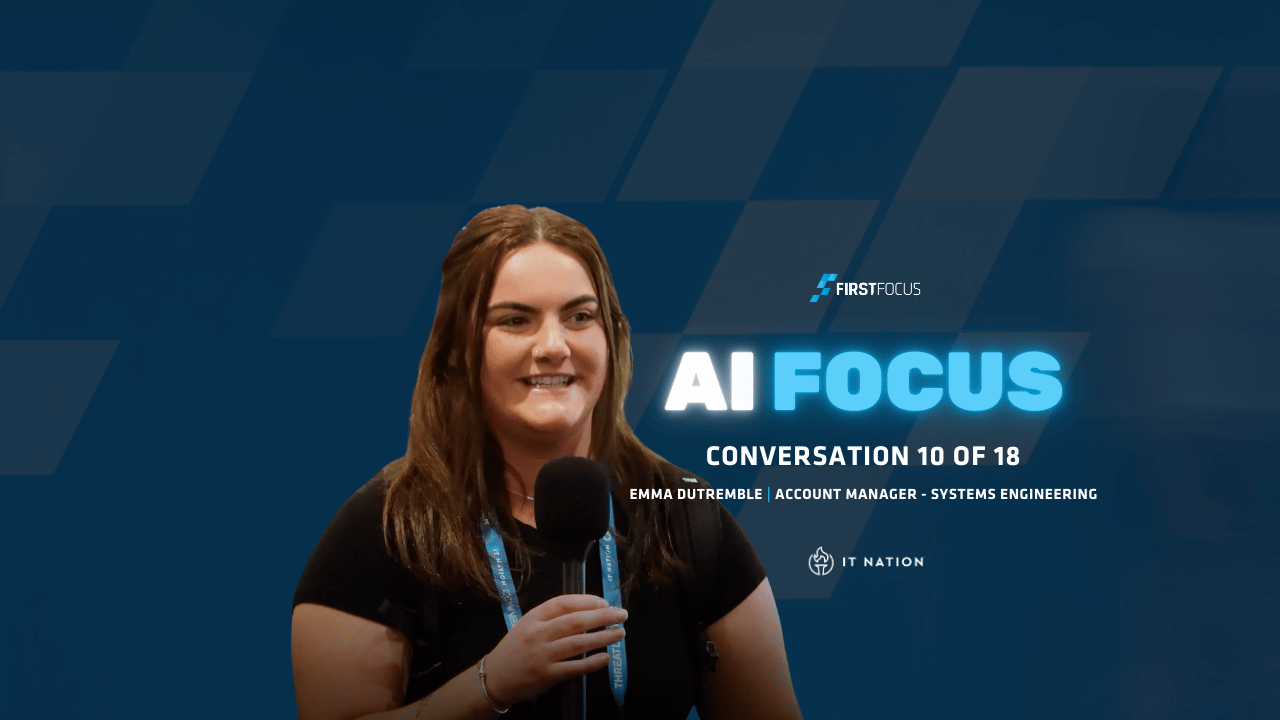
How MSP Account Managers Are Using AI to Learn Faster and Strengthen Client Conversations
In this AI Focus episode recorded at IT Nation Connect in Orlando, Brendan Ritchie speaks with Emma Dumble, an account manager from Systems Engineering in Portland, Maine. The discussion highlights how AI is becoming a practical learning companion for new professionals in the managed services sector and how tools like Copilot are reshaping internal capability and client engagement. While not an Australian story, the lessons carry strong relevance for MSPs and business leaders across Australia who are navigating rapid change, growing workloads, and shifting customer expectations.
Key takeaways
- AI tools like Copilot are becoming essential learning aids for new professionals entering the MSP industry.
- AI-supported preparation helps make executive business reviews clearer and more strategic for clients.
- Copilot is widely used within MSPs for productivity, chat assistance, and internal communication.
- AI helps translate technical concepts into business-focused language for client conversations.
- Many younger professionals feel AI improves efficiency but may also reduce independent thinking if overused.
- The MSP industry is challenging to learn due to jargon, abbreviations, and limited crossover with other fields.
- AI is a valuable companion for continuous learning and skill-building in a fast-paced environment.
- There is healthy scepticism about AI’s impact on critical thinking, creativity, and long-term capability.
- Despite concerns, AI’s ability to accelerate prep, research, and communication provides clear business value.
Watch the episode
AI becomes a learning companion for MSP account managers
Emma’s role at Systems Engineering involves managing a book of clients, leading strategic conversations, and supporting long-term planning. Like many who enter the MSP industry, she faced a steep learning curve. There are layers of terminology, frameworks, and delivery models that rarely exist in other sectors. For people entering the industry fresh, it can feel like learning a new language while simultaneously learning how to advise clients.
This is where Copilot became a critical part of Emma’s workflow. Rather than using the tool for PowerPoint building or document drafting, she relies on the chat capability to clarify terms, translate technical detail into business context, and understand how to frame conversations with clients. For new account managers and sales professionals in Australia, this is becoming a common pattern. AI helps flatten the learning curve so that teams can contribute value faster.
Emma uses the chat interface to simulate conversations, prepare for executive business reviews, and identify how to articulate complex concepts in a way clients can easily digest. This is where AI becomes more than an automation tool. It becomes a coach.
Translating technical insights into business value
One of the ongoing challenges for MSPs is bridging the gap between technical delivery and business priorities. Account managers must convert detailed system information into clear recommendations that support long-term planning, security, and operational outcomes. AI chat tools are proving highly effective for this task.
- They simplify jargon-heavy explanations.
- They help identify business impacts and risks.
- They allow for quick comparisons and definitions.
- They support rapid preparation for strategy discussions.
For Emma, this capability is especially important given the rapid pace of learning required in her role. For Australian MSPs facing talent shortages and onboarding challenges, AI-assisted upskilling helps new employees get client-ready sooner without compromising quality.
How Copilot is being used inside MSPs
According to Emma, Copilot is widely adopted within her organisation, particularly for internal productivity. Her colleagues use it extensively for PowerPoint creation, summarisation, and general admin assistance. Across Australia, MSPs are reporting similar patterns. Staff use Copilot to create proposals, summarise tickets, write emails, or complete tasks that previously took hours.
Emma’s unique use case highlights the importance of matching AI tools to individual roles. While technical staff may use it for coding assistance or documentation, customer-facing staff can use the same tool for learning, research, and communication support.
AI scepticism and the impact on independent thought
While Emma appreciates AI’s usefulness, she also acknowledges a concern shared by many younger professionals. With tools like Copilot and GPT becoming ever-present across daily workflow, it can feel like some essential thinking skills are fading.
She explains that writing tasks she previously handled independently now feel harder without leaning on AI. Executive summaries, analysis pieces, and other strategic content can be produced in seconds with AI, but that speed can encourage mental shortcuts. It is a trade-off many organisations are now examining.
When AI becomes an automatic part of the process, people may rely on it before attempting to think through a problem themselves. This raises important questions for Australian businesses as AI becomes more embedded in operations.
- How do we maintain critical thinking while using AI?
- When should AI support be encouraged and when should it be limited?
- What tasks should remain human-led for capability development?
Emma’s reflection captures a growing sentiment. AI makes everything easier, but it also changes how we build expertise. The challenge is ensuring teams continue developing foundational thinking skills while still benefiting from the efficiencies AI provides.
The balance between efficiency and capability
Brendan highlights an important point during the conversation. Tasks that previously took days can now be completed in minutes. This is especially useful for MSP account managers managing workloads across multiple clients and deadlines. Speed matters, particularly when preparing deliverables that shape strategic decisions.
However, the speed advantage must be balanced with the need for capability development. When staff rely exclusively on AI, their understanding of concepts can weaken over time. For leaders in Australian MSPs, this balance should be managed deliberately through training, mentoring, and structured expectations.
AI should support thinking, not replace it.
Why AI still delivers undeniable value
Despite her scepticism, Emma is clear about the value Copilot provides. It makes her more effective, more confident, and better prepared for client conversations. It also supports ongoing learning, especially in moments where quick clarification is needed. AI enables rapid access to knowledge that would otherwise require long research or peer support.
For MSPs across Australia, this is one of the strongest use cases for AI today. It accelerates competence, strengthens communication, and gives newer staff the confidence needed to engage strategically with clients.
Emma’s final view is balanced. She recognises AI as a powerful resource, but one that should complement human capability, not replace it. For organisations navigating the same journey, this perspective is meaningful and practical.
Shaping the next generation of MSP talent
The conversation ends on an optimistic note. AI may present challenges, but it also opens opportunities for people entering the industry. With the right guidance, AI can help new professionals grow faster, master complex concepts, and deliver high-value client experiences sooner.
For Australian businesses, especially MSPs delivering strategic services, the key is ensuring AI strengthens capability, enhances communication, and supports the long-term development of your teams. Emma’s experience reflects the new normal in the industry. AI is here, it is useful, and when used thoughtfully, it elevates the quality of client engagement.