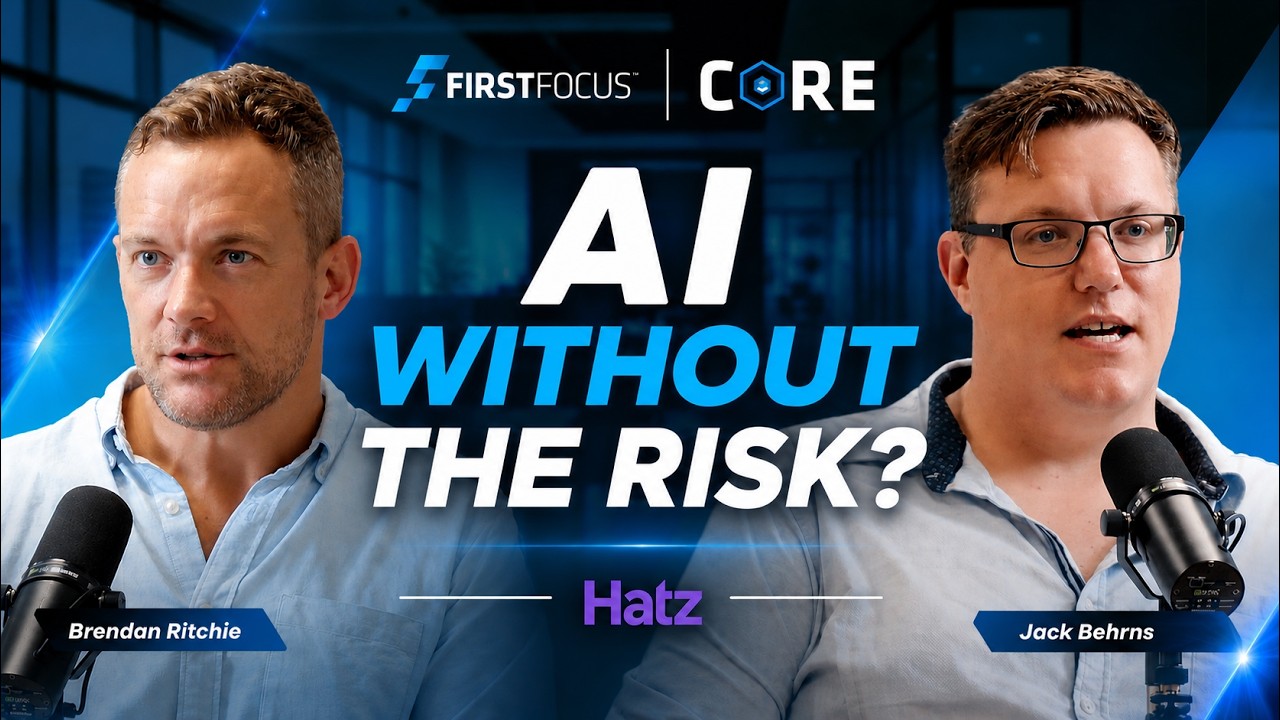
Brendan [0:00]: Jack, I’ve dragged you in here because you know everything about Hatz. It’s a multi-modal AI platform, with 50 or so models behind it, and it keeps growing.
Jack [0:09]: Fifty-nine at the moment, I think. And we’re about to turn on the latest ChatGPT models as well.
Brendan [0:16]: So at a high level, when we talk about Core and the AI tools you can use with it, there’s Copilot, there’s ChatGPT, and there’s Hatz. Tell us how Hatz is different and what use case it suits.
Jack [0:35]: Hatz plays a different role to the other two. ChatGPT is brilliant when a company needs to all be in the same ecosystem, especially companies that aren’t doing much with AI yet. Everyone gets one system and speaks the same language. Hatz is better suited to businesses that already have people adopting AI on a per-user level, often without oversight. If your finance team is using one model because it’s strong with spreadsheets, and your marketing team is using another because it’s good at generating images, Hatz brings all of those models into one platform and lets people choose what they want to use. It does that in a secure, governed way, with oversight of how it’s used, the models set so they’re not learning on your data, and everything sitting in one data centre with governance controls over the top. So Hatz fits when you’ve got people already using models and you don’t want to take anything away from them. You just want to give it to them in an environment that’s safe to use.
Brendan [1:50]: So it lets you stop people using shadow AI, but without saying no. This is something Russ and I talked about recently. It’s hard to decide which model to back. It’s one of those Google-or-Microsoft moments. What you’re saying is you don’t have to pick. You pick one interface, and through it you can reach all of them in a safe, governed way.
Jack [2:11]: Correct. We’re giving that advice to customers all the time. The answer to “what models should I use” isn’t the same as it was two weeks ago, and it won’t be the same in a month. Choosing a platform takes a lot of money and time to get people to adopt, and you don’t want to rip the carpet out from under them every time a better model is released. Hatz solves that. Once your people are in the system, and First Focus has spent the time at your premises talking to department heads, running hackathons and adoption challenges, we can just keep adding models as they’re released. We’re not landing on something today and hoping it’s still relevant in twelve months.
Brendan [3:16]: So the employee experience isn’t disrupted, your people stay happy, and you get the most from AI without being limited to whichever model is winning that month. Next, let’s talk about the interface. To those who haven’t seen it, what does it look like, and what do you have to get used to?
Jack [3:44]: Day one, when a user logs in, every user gets the same experience. You get a landing screen with a welcome to Hatz and a welcome to First Focus, and the Hatz agent. That agent is another version of Sam, our AI assistant that we run internally and that clients see in F-Connect. It’s the onboarding guide. It teaches users how to get into the learning platform to do their AI Champion certification, which is a good way to upskill people and give them the toolkit to build their first workflow. Other than that, the main difference between Hatz and a ChatGPT, a Claude or a Meta is the colour scheme. They all serve the same purpose, and in Hatz you select which model you want to use. If your people have used any of those platforms, they’ll feel right at home.
Brendan [5:00]: So if I’m using ChatGPT through Hatz, the projects and custom GPTs should feel pretty natural?
Jack [5:07]: Yes. The wording changes. ChatGPT calls its agents custom GPTs, so that’s what they’re called in that ecosystem. In Hatz they might be called apps or agents, and workflows are named something else again if you do it in Google. But apart from wording changes, it’ll feel right at home.
Brendan [5:28]: How is it so much cheaper?
Jack [5:32]: When we buy credits, we can either license a single user, like ChatGPT, where each user needs their own licence, or we use Hatz, where we build isolated instances for customers but buy the AI usage in the back end as one large pool. We can then sell that on at a reduced price. Passing that reduction on to customers was something we wanted to do when we went to market. One of the important factors was finding a price point well below the competition. It’s economy of scale.
Brendan [6:23]: So we charge per user per month, but the back end is a consumption-based model.
Jack [6:29]: We buy credits in a big pool and split them out, so we buy at enterprise pricing and release them at SMB pricing for the SMB market.
Brendan [6:41]: For someone who doesn’t understand the consumption model, what does a token represent and how does it work?
Jack [6:51]: Any time you talk to AI, it splits what you say, the input and the output, into tokens. Sometimes a token is a full word, sometimes a word part, sometimes punctuation or the spaces between words. So tokens are the individual pieces the AI counts as something it has to process.
Brendan [7:14]: Cool. Last piece is Hatz themselves. They’re an American outfit.
Jack [7:23]: They’ve got people all over the place. When we jump on a meeting there are representatives all around the world, so it’s a combination of strong people regardless of where they sit. The data is currently housed in AWS instances in America. That’s where it’s living, but watch this space.
Brendan [7:46]: Nice. Let’s leave it there for now, but it’d be good to check in again once we’ve got some wins on the board, with real stories on ROI and adoption from the clients who’ve signed on.
Jack [8:03]: We’ve got analytics starting to feed back from the first customers using it, and we’ve already turned some of that feedback into new solutions. It’s iterating quickly and the development team is very responsive. We’ll have a lot more to share over the next month on analytics and ROI.

 IT Consulting
 Data Services
 IT Infrastructure Projects
 IT Procurement
 Business Continuity Planning
 Cloud Migration Services
 Managed IT Services
 IT Support Services
 Managed Cloud Services
 Managed SharePoint Services
 End User Computing
 Unified Communications
 Connectivity
 Virtual CIO
 Offshore Staff Outsourcing (BPO)
 Managed Security Services
 ACSC Essential 8
 Cybersecurity Risk Assessment
 Cloud Backup and Disaster Recovery
 Cyber Security Connect and Protect Program
 Automation
 IT Strategy
 Microsoft 365 Consulting
 Power BI
 Careers
 Awards and Certifications
 Management Team
 Case Studies
 Sell Your IT Business
 Our Commitment to the Environment
 CSAT Charity Donations
 Media Kit
 Sydney