Artificial intelligence might be the hottest topic in business right now, but for many Australian organisations it still feels abstract. Every vendor claims to have AI built in. Every platform says it’s intelligent. But when you strip away the hype, what are real technical leaders actually using day to day? And what impact is AI having on the teams who build the systems your business relies on?
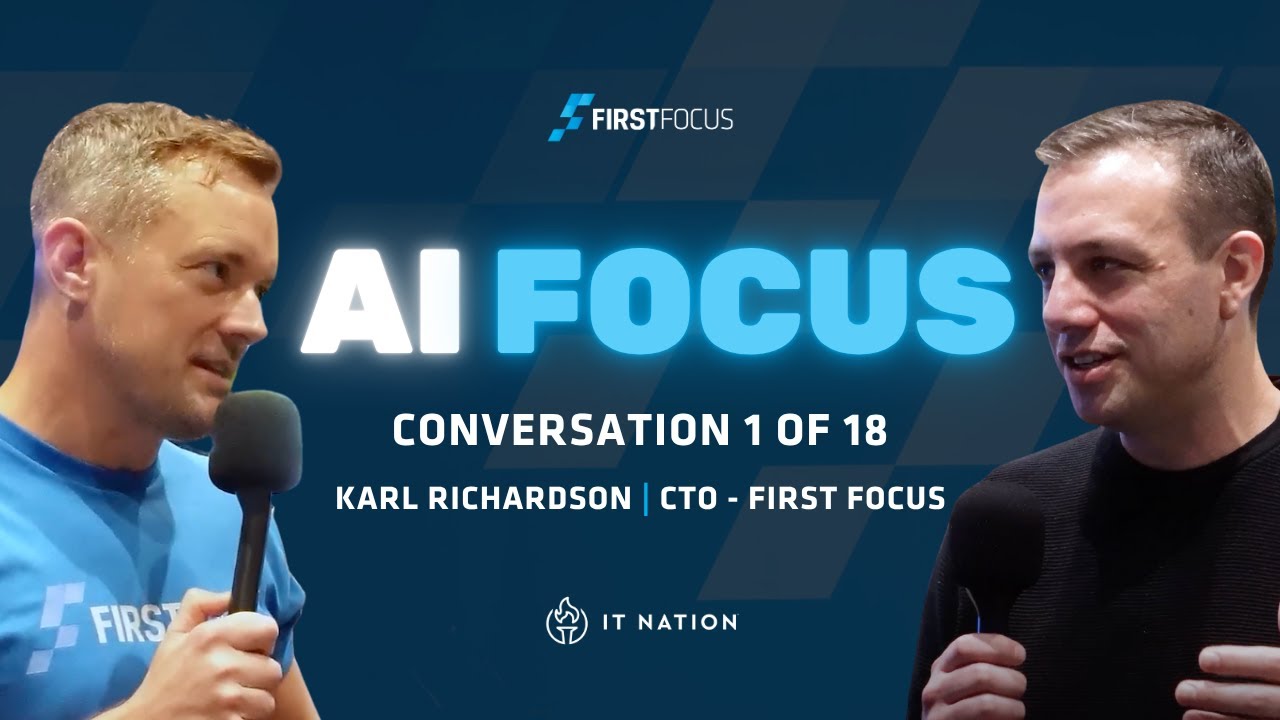
To find out, we sat down with Karl Richardson, CTO of First Focus, an Australian and New Zealand MSP supporting mid-market organisations. Karl leads the company’s technical direction and oversees the software development team as they navigate the rapid wave of AI-enabled change.
Fresh from speaking at IT Nation Connect 2025 in Orlando, Karl offered a candid, practical look at how AI is reshaping software development, what tools are genuinely making a difference, and where the risks still sit for businesses adopting AI too quickly.
This is not theory. This is what a hands-on CTO is using in production, right now.
When asked about his favourite AI tool, Karl didn’t hesitate: Lovable.
Lovable is part of the new generation of vibe coding platforms, tools that allow developers to build applications using natural language instead of writing line-after-line of code manually. The result is a massive acceleration in development cycles.
Karl recently used Lovable to build an internal road-mapping application for First Focus.
In the past, that project would have required:
With Lovable, he built the entire application in six hours.
For mid-market Australian businesses, this is a glimpse into what near-future internal development could look like: rapid prototyping, lower cost of experimentation and new tools appearing almost weekly.
Despite the speed benefits, AI is not replacing developers. If anything, Karl says it is making both junior and senior developers more valuable.
AI gets teams to 80 percent faster
Modern AI coding assistants allow developers to start with a functional draft instead of a blank page. With a few sentences of instruction, the system can generate roughly 80 percent of the required code instantly.
This saves hours of manual effort and helps teams ship features significantly faster.
Juniors learn faster, seniors review deeper
For junior developers, AI provides an accelerated learning pathway. Instead of struggling to produce working code from scratch, they can study AI-generated examples and iterate.
Senior developers, meanwhile, become even more essential. They act as the quality gatekeepers, reviewing code for:
Karl’s view is clear: AI doesn’t remove the need for expertise. It amplifies it.
Karl notes that his team uses tools like Cursor, an AI-enabled integrated development environment.
Tools in this category help developers:
This is where the development industry is moving: AI not just helping with code generation, but validating it, testing it and helping developers ship safely.
While AI development platforms are powerful, Karl warns they can also create new risks if used carelessly.
Because non-developers can now build apps with almost no coding knowledge, many organisations may unintentionally introduce:
The danger, Karl says, is not in building the app, it is in understanding what AI has built.
Lovable and similar tools are rapidly adding security scanning and linting to reduce risks, but business leaders should still ensure anything created by AI is reviewed by a qualified developer.
The takeaway?
AI can help you build faster, but it cannot replace the judgement of someone who understands software deeply.
While AI is unlocking new possibilities, Karl is cautious about certain emerging trends, especially AI agents that imitate human behaviour by navigating web browsers, filling out forms and performing tasks automatically.
The problem?
These agents can make mistakes, and when those mistakes involve financial or customer-facing decisions, the consequences can be costly.
Karl highlights areas of particular concern:
And then there’s the data governance issue. With AI being fed more business data than ever, the quality, permissions and accessibility of that data matter more than ever.
As Karl puts it: “Garbage in, garbage out. Data is the food of AI.”
For Australian businesses, this is a reminder that AI strategy cannot be separated from governance, access control and strong internal policy.
Despite the risks, Karl is energised by the potential of AI, especially in a mid-market context.
First Focus serves a diverse set of industries across Australia and New Zealand, each with unique workflows, challenges and opportunities. Karl sees enormous potential in how AI could improve operations across every vertical.
Whether it is automation in professional services, forecasting in manufacturing, workflow optimisation in healthcare or customer engagement in retail, the breadth of possible AI use cases is what excites him most.
For business leaders, the message is clear:
We are just at the beginning, and the organisations that learn fast will gain advantage fast.
Talking to Karl makes one thing obvious, the gap between AI hype and real-world usage is closing quickly.
Here’s what matters most for Australian business leaders right now:
But you do need to understand what AI can accelerate for you.
Permissions, data quality and oversight matter more than ever.
It makes good developers faster and makes great developers indispensable.
Use it, but always get expert review.
Six-hour apps are no longer fantasy.


 IT Strategy
 IT Consulting
 Data Services
 IT Infrastructure Projects
 IT Procurement
 Business Continuity Planning
 Virtual CIO
 Cloud Migration Services
 Managed IT Services
 IT Support Services
 Managed Cloud Services
 Managed SharePoint Services
 Unified Communications
 Connectivity
 Offshore Staff Outsourcing (BPO)
 Managed Security Services
 ACSC Essential 8
 Cybersecurity Risk Assessment
 Cloud Backup and Disaster Recovery
 Cyber Security Connect and Protect Program
 Automation
 Power BI
 Careers
 Awards and Certifications
 Management Team
 Case Studies
 Sell Your IT Business
 Our Commitment to the Environment
 CSAT Charity Donations
 Media Kit
 Sydney