Most businesses are now spending real money on AI, modern software, and new tools. A lot of them are not getting the return they expected. Staff are using features they don’t fully understand. Platforms get rolled out and struggle to get traction. Licences sit idle. The spend goes up. The productivity gains don’t show.
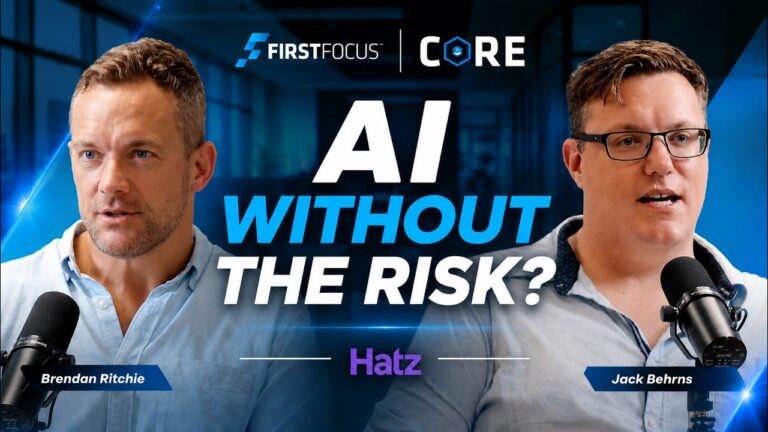
First Focus CEO Ross Sardi and Chief Growth Officer Brendan Ritchie sat down recently to talk about why this is happening, why the traditional Managed Service Provider (MSP) model doesn’t fix it, and what needs to change. The short version: the job of a technology partner is shifting from keeping the lights on to actively helping a business get more out of its people and its tools.
That shift is the idea behind a new First Focus offering called CORE. It’s what the team describes as “Productivity as a Service”.
Prefer to read? The key points from the episode are below.
The usual MSP job is to support devices, patch servers, and fix what breaks. Some providers have answered the AI question by adding a line item to the invoice. Pay ten dollars extra a month and get “managed AI”.
Ross’s view is that this approach misses the point. Selling an AI licence is not the same as helping a business get value from AI. Solving a single use case is not the same as lifting productivity across the company.
Most MSPs in the market have not been willing to change the model. It’s hard to disrupt yourself. But the businesses First Focus is speaking to are already feeling the gap. They know they need to do something with AI and automation. They just don’t know what, or how to get a return from it.
CORE brings five things together under one service:
The last point matters the most. A tool that no one adopts is not a productivity gain. It’s a line item on a bill.
At the end of 2024, Ross asked First Focus clients what they wanted to know more about and what problems they were trying to solve. Two answers dominated: AI and automation, and “I hate how I’m using SharePoint”.
That hasn’t changed. The bulk of the uplift work First Focus is now doing with new customers is security, SharePoint, and AI and automation. The old world of “I’ve inherited three servers that need replacing” is mostly behind us.
Most organisations are using SharePoint to some degree. Almost none are happy with it. Permissions are unclear. Nobody is sure what’s being shared or with whom. The value is locked up inside a platform people don’t trust.
CORE picks this up directly, with deep SharePoint expertise inside the service rather than a surface-level tidy-up.
CORE sits at a higher monthly price point than a traditional managed support plan. The value conversation, according to Brendan, is the easiest he’s ever had.
The framing is simple. If we save every person in your business an hour a month inside the first three months, what does that look like? What happens to your profit and loss? What else could those people be doing with that time?
When a Technical Account Manager sits down every month and asks “what are we automating this month?” and “what are we doing to improve productivity this month?”, that’s a very different relationship to the one most MSPs offer.
One debate inside the MSP industry is whether providers should build AI agents and use cases that customers can simply pick up and use. Ross’s view is that this is the wrong approach.
There’s no such thing as a templated business. The subject matter experts inside each department know what needs to change better than any outside party. The MSP’s job is to enable those people to do the work, to do it securely, and to provide the technical depth to finish the last 20 percent that the business can’t do on its own.
AI coding tools are a useful comparison. Anyone can now get to 80 percent on their own. The final 20 percent still needs real technical capability.
Under CORE, the “technical” part of Technical Account Manager is almost the wrong word. The role moves closer to senior business advisor.
It’s about understanding how the marketing team actually works. Where the finance team’s islands of information are. Which workflows could be automated. Which systems should talk to each other but don’t. Why a new hire has been proposed, and whether a better workflow might do the job instead.
First Focus has a principle it calls the First Focus Method. One of its ideas is to shift thinking from “the printer’s not working” to “how do we make it so we never have to print again”. CORE applies that lens to every workflow in a business.
A good CORE customer contact is often not just the IT manager. It’s often the heads of departments who feel the friction of manual work every day and want it gone.
Earlier this year First Focus ran an AI Investment Fund, putting $100,000 towards real AI projects inside the client base. More than 30 organisations submitted ideas. Five were chosen to move ahead, and the projects give a practical picture of what AI and automation look like when they’re solving real business problems rather than ticking a box.
The winning projects:
Across all 30-plus submissions, four themes came through repeatedly: workflow automation, AI assistants, data consolidation and governance, and analytics and forecasting. Those are the same areas CORE is built around, which is the point. The winning ideas get the initial build. CORE is what makes sure they keep delivering value after the launch.
More on each project is at firstfocus.com.au/ai-fund.
CORE is a fit for organisations that:
Businesses that aren’t ready for this conversation yet can still work with First Focus on more traditional services. Ross’s view is that any business not all in on AI and automation today will be in two to three years.
Building CORE has been a deliberate reset rather than a set of add-ons. A few of the moves behind the scenes:
If your business is spending on AI, automation, and modern tools but the returns aren’t showing up yet, this is the conversation to have. The issue is rarely the technology itself. It’s adoption, data, governance, and whether the right people are being asked the right questions.
CORE is First Focus’s answer to that. Productivity as a Service, backed by a team built for the job.
If you’d like to talk about whether CORE is a fit for your business, get in touch.

 IT Consulting
 Data Services
 IT Infrastructure Projects
 IT Procurement
 Business Continuity Planning
 Cloud Migration Services
 Managed IT Services
 IT Support Services
 Managed Cloud Services
 Managed SharePoint Services
 End User Computing
 Unified Communications
 Connectivity
 Virtual CIO
 Offshore Staff Outsourcing (BPO)
 Managed Security Services
 ACSC Essential 8
 Cybersecurity Risk Assessment
 Cloud Backup and Disaster Recovery
 Cyber Security Connect and Protect Program
 Automation
 IT Strategy
 Microsoft 365 Consulting
 Power BI
 Careers
 Awards and Certifications
 Management Team
 Case Studies
 Sell Your IT Business
 Our Commitment to the Environment
 CSAT Charity Donations
 Media Kit
 Sydney